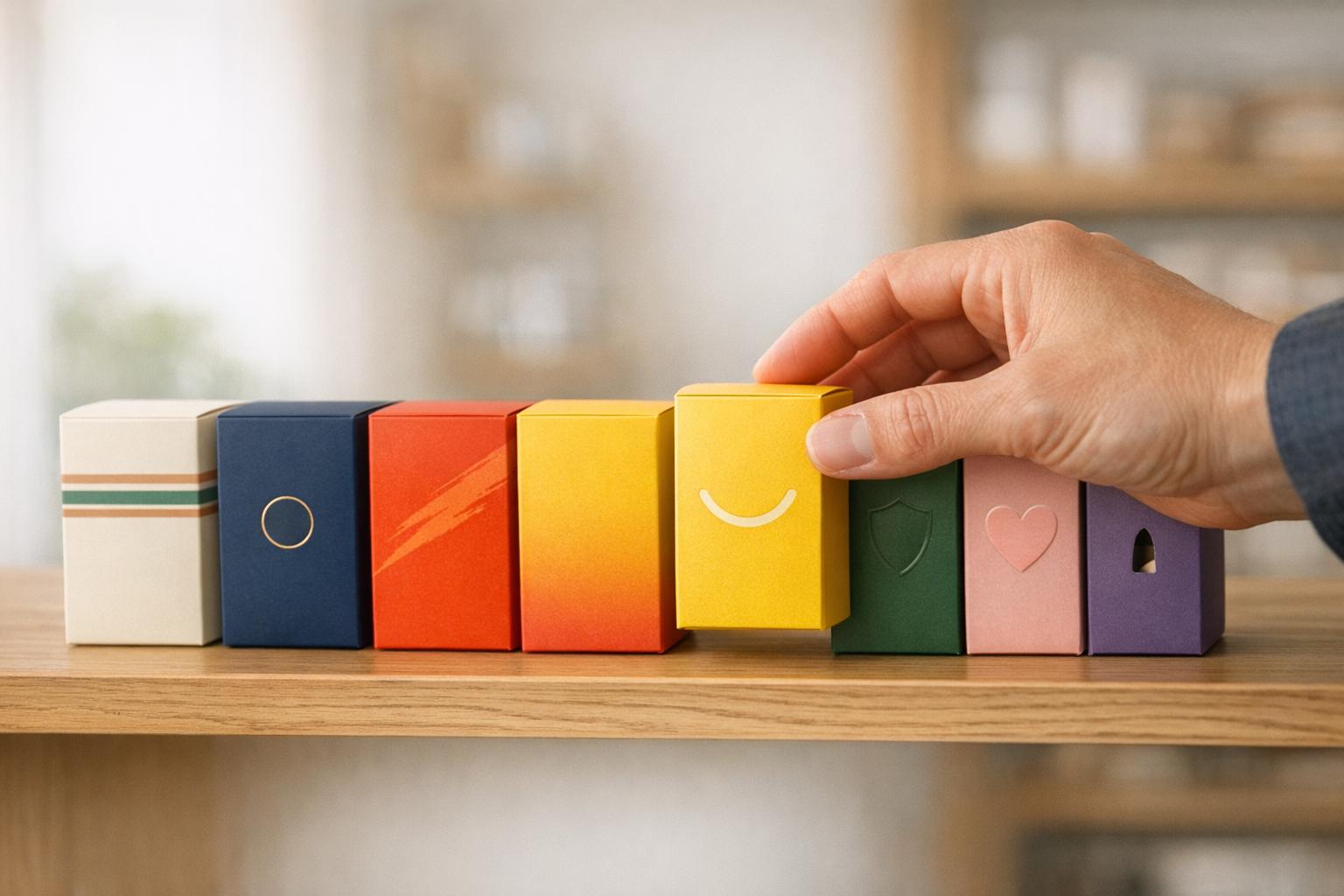

Structural packaging design is the backbone of how products are stored, shipped, and presented. Although it can be about aesthetics - it's all about creating packaging that works: protecting contents, surviving shipping, and standing out on shelves. Here's why it matters:
- Functionality: Ensures products are easy to open, reseal, and handle.
- Material Selection: Balances durability, cost, and recyclability.
- Impact on Business: 30% of companies report revenue growth after upgrading packaging, and 63% of consumers say packaging affects brand perception.
- Retail vs. E-Commerce: Retail packaging focuses on shelf appeal, while e-commerce packaging prioritizes durability during transit.
- Sustainability: Smart engineering can reduce material use by up to 80%, cutting costs and waste.
PKG Brand Design explores how structural packaging influences consumer behavior, enhances product safety, and supports eco-conscious goals - all while driving sales and brand trust.
Core Principles of Structural Packaging Design
Structural packaging design revolves around three main principles: physical form, functionality, and material selection. Together, these elements ensure packaging not only protects and performs but also grabs attention. When the shape, graphics, and materials work as a cohesive system, the result is packaging that stands out on shelves and drives consumer interest. As PMMI ProSource explains, "There is a dialogue that happens between graphics and shape that makes the sum of that dialogue greater than its parts". Each principle plays a unique role in creating packaging that delivers both visually and practically.
Physical Form and Visual Impact
The shape of a package does more than hold a product - it tells a story. A distinctive shape can instantly communicate quality and evoke emotions, making it a powerful tool for standing out in crowded retail spaces. For example, hexagonal boxes, rigid tubes, or custom-contoured designs can draw attention and even justify higher price points. Beyond aesthetics, the physical form must also serve practical purposes, such as stacking efficiently, surviving shipping, and making an impression on the shelf.
Tactile details like the grip of a bottle, the balanced weight of a container, or the suction of a lid can further signal quality before the product is even used. To get it right, start with a detailed design brief that outlines both "hard" requirements (such as volume, cost, and compliance) and "soft" goals (like brand identity and emotional impact) before diving into prototypes.
Functionality and Ease of Use
How a package functions directly impacts the consumer experience. From easy-open features to resealable closures and ergonomic designs, functionality can determine whether a customer returns for more. Closures, in particular, play a vital role since they’re often the main point of interaction between the consumer and the product.
A great example of functional design is Go-Gurt’s squeeze-tube packaging, which eliminated the need for a spoon and made yogurt a convenient on-the-go snack. This simple structural innovation created a whole new way to enjoy the product. Functionality also extends to safety features, such as child-resistant closures for household cleaners or prescription medications. The goal is to design packaging that fits seamlessly into everyday life, whether it’s a carton that slides easily into the fridge door or a bottle cap that’s easy to twist, even with wet hands.
Material Selection and Strength
Choosing the right materials is a balancing act between durability, cost, and environmental considerations. For instance:
- Corrugated cardboard provides excellent protection for heavy shipments.
- Rigid boxes made from thick cardboard create a luxurious feel for high-end items like smartphones and watches.
- Paperboard is a lightweight yet durable option for products like milk cartons, frozen foods, and cosmetics.
- Chipboard works well for cereal and tissue boxes, offering a large printable surface but limited moisture resistance.
Material choice also impacts how well the packaging protects its contents during transit and storage. According to Leo Chao, Creative Director at Zenpack, "Structure first. Materials second". This approach ensures the package’s engineering is sound before optimizing for sustainability or cost. Techniques like folding can add strength without increasing material thickness, while applying Design for Manufacturability (DFM) principles ensures even the most creative shapes can be mass-produced efficiently. The ultimate goal is to strike a balance between protection, cost-effectiveness, and environmental responsibility, all tailored to your brand’s specific needs.
sbb-itb-0c3a5ed
Structural Design for Retail and E-Commerce
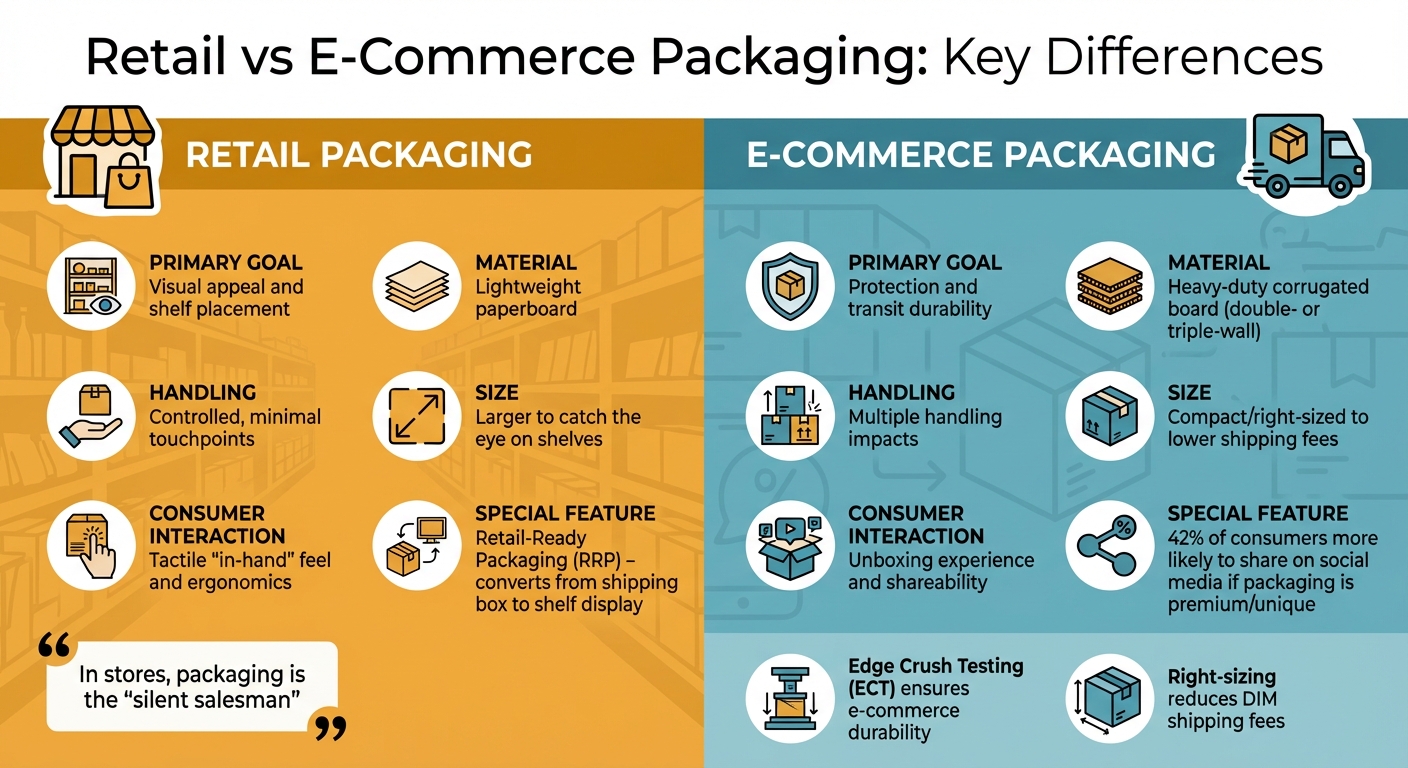
Retail vs E-Commerce Packaging Requirements Comparison
Packaging designed for retail shelves often struggles to meet the demands of shipping. That’s because retail and e-commerce have very different requirements, and each channel calls for its own specific design approach. These tailored strategies build on the basics of design - form, functionality, and material strength - while addressing the distinct challenges of each environment. As Scott Kuhnel aptly put it, "In stores, packaging is sometimes referred to as the 'silent salesman'". On the other hand, e-commerce packaging must endure the rough handling of shipping depots, courier transfers, and the occasional drop. This divergence in needs makes it essential to craft packaging solutions that cater to each channel’s unique demands.
Retail-Ready Packaging (RRP)
Retail packaging has two primary goals: to grab attention and make restocking easy. Retail-Ready Packaging (RRP) is a clever solution that combines shipping and display functions. A great example is PDQ (Pretty Darn Quick) trays, which allow store employees to convert a shipping box into a shelf display simply by removing a perforated panel. In retail, packaging design focuses on stackability and efficient use of shelf space. Lightweight paperboard is a common material choice because it reduces costs and works well for bulk shipments on pallets, which experience minimal handling.
It’s important to note that packaging in retail isn’t just about logistics - it plays a major role in influencing buying decisions. While retail packaging emphasizes visual appeal and ease of use, e-commerce packaging has to address a completely different set of challenges.
E-Commerce Packaging Requirements
E-commerce packaging faces a tougher road - literally. It has to protect products through multiple transfers, conveyor belt drops, and exposure to conditions that can weaken adhesives. To meet these demands, packages often use heavier materials like double- or triple-wall corrugated board. These materials are reinforced with features like custom die-cuts and shock-absorbing fluting to ensure durability. Tests like Edge Crush Testing (ECT) simulate the stacking pressures and transit risks parcels face, ensuring the packaging can handle the journey.
But protection isn’t the only focus. The unboxing experience has become a critical moment for brands. In fact, 42% of consumers are more likely to share a product on social media if it arrives in premium or unique packaging. This means the inside of the box matters just as much as the outside. Custom inserts not only secure the product but also enhance the overall experience. Additionally, right-sizing the box to fit the product helps reduce dimensional weight (DIM) shipping fees and minimizes the need for excess filler materials. As Kevin Keating, President at PKG Brand Design, explains, "Within the e-commerce journey, packaging is the first physical interaction a customer has with your brand — setting expectations, signaling quality, and shaping lasting impressions from shipment to unboxing."
| Feature | Retail Packaging | E-Commerce Packaging |
|---|---|---|
| Primary Goal | Visual appeal and shelf placement | Protection and transit durability |
| Material | Lightweight paperboard | Heavy-duty corrugated board |
| Handling | Controlled, minimal touchpoints | Multiple handling impacts |
| Size | Larger to catch the eye on shelves | Compact/right-sized to lower shipping fees |
| Consumer Interaction | Tactile "in-hand" feel and ergonomics | Unboxing experience and shareability |
Environmentally Responsible Structural Packaging
As packaging evolves, it's not just about looking good or being functional - it’s about being responsible. Today, the focus is on designing packaging that minimizes environmental impact. As Leo Chao, Creative Director at Zenpack, puts it:
"Structure first. Materials second".
By prioritizing smart engineering, it's possible to reduce material use by as much as 80% without compromising protection. This approach aligns with the growing need for sustainability in consumer packaged goods (CPG) design.
Using Environmentally Friendly Materials
Sourcing materials responsibly is a key step toward sustainable packaging. FSC-certified fiber, post-consumer recycled (PCR) content, and plant-based materials are all excellent choices to lower reliance on virgin resources and fossil fuels. For example, Coca-Cola’s switch to 100% rPET bottles for its Dasani brand in 2022 eliminated 80 million pounds of virgin plastic - roughly equal to 2 billion bottles.
When selecting materials, think about the total cost of ownership (TCO). This includes not just the purchase price but also savings from lighter packaging (lower freight costs), faster assembly times (reduced labor), and lower waste disposal fees. Extended Producer Responsibility (EPR) laws in states like California, Oregon, and Colorado add another layer of cost consideration. These laws adjust fees based on recyclability - materials that are easier to recycle incur lower fees, while harder-to-recycle options cost more. For instance, in Oregon, multi-layer flexible film can attract fees as high as $1.43 per pound, while simpler materials like Kraft paper and corrugated board cost just $0.03 per pound.
| Material Type | Performance Characteristic | Cost Impact |
|---|---|---|
| PCR Plastics | Durable; meets MRC mandates | Higher unit cost but lowers EPR fees |
| FSC Fiber | Strong, lightweight, recyclable | Standard pricing; requires Chain of Custody |
| Biobased Plastics | Renewable; reduces fossil fuel use | Higher R&D and unit costs |
| Triple-Wall Board | High compression and stacking strength | Higher material cost but prevents product damage |
Designing for Reduced Material Use
Reducing waste starts with smart design. Packaging tailored to fit products precisely eliminates the need for void fillers, saving on shipping and storage costs. Tools like Finite Element Analysis help identify stress points, allowing for targeted reinforcements where they’re needed most. Even small adjustments, like using strategic folding patterns or selecting the right corrugated flute profile (e.g., B/C-flute), can add strength without increasing material usage.
A great example is Planters, which redesigned the packaging for its 16-ounce Dry Roasted Peanuts. By cutting down on plastic, they reduced usage by 8%, saving an estimated 220 tons of plastic annually - all while maintaining product quality and shelf appeal. Another effective strategy is optimizing die-line layouts to maximize material yield and minimize waste during production. Lightweight materials can still perform well with reinforcements like handle patches or bottom boards, ensuring durability without excess bulk.
Curbside Recyclability and Compostability
Sustainability doesn’t stop at material efficiency - it extends to what happens after the packaging is used. Designing for recyclability means understanding how materials are processed. Mono-material packaging, made from a single type of material like all-paper or all-PET, simplifies recycling at Material Recovery Facilities (MRFs) and boosts recovery rates. On the flip side, materials like plastic films, which can jam sorting equipment, should only be used if local facilities can handle them. In California, for example, detachable components like jars and lids are reported separately, making separable designs a smart choice for better recycling outcomes.
Corrugated board remains a recycling champion, with about 70% of cardboard boxes in the U.S. being recovered and recycled. For items contaminated by food, compostable packaging offers an alternative. However, it’s important to differentiate between "biodegradable" and "compostable." Compostable materials often require industrial facilities and specific conditions to break down properly. Tools like QR codes or "Recycle Check" labels can guide consumers on how to recycle correctly, as curbside standards vary widely across municipalities.
Ultimately, if a product spoils or breaks, the wasted resources and energy used to create it are far worse for the environment than wasting packaging alone. Thoughtful design helps avoid both.
Prototyping, Manufacturing, and Production Scale
Once the digital design is approved, the next step is to test how the packaging performs in real-world conditions. Transitioning from concept to production involves ensuring the packaging is both functional and scalable for efficient manufacturing.
Prototyping and Testing Structural Designs
Start with a phased approach to testing to save both time and resources. Early on, digital mockups like 3D renders or CAD files allow for quick visual validation. For physical testing, laser-cut samples are a cost-effective way to check dielines, fit, and folds without expensive tooling. These samples, typically ready in 2–7 days, can uncover issues such as score-cracking. If cracking occurs, you might need to upgrade the board grade or switch to a stronger varnish. Unprinted white samples are another step to verify product fit and clearances before moving to full-scale production.
For more precise testing, press-proofs or short-run production are invaluable. These prototypes use actual materials and printing processes, which help identify potential issues with color accuracy, finishes like foil or embossing, and structural integrity. Though they take 5–14 days and are more expensive, they act as the final safeguard before mass production. As 7packaging aptly states:
"Beautiful boxes die in testing. Great boxes win it and ship".
To ensure durability, prototypes should undergo ISTA (International Safe Transit Association) testing, which includes drop, vibration, compression, and humidity assessments. For example, a direct-to-consumer candle company revamped its packaging with E-flute mailers and molded pulp after failing drop tests. This redesign not only reduced breakage by 82% but also cut pack-out time by 19%.
Once prototypes are validated, it’s crucial to confirm that the design can be efficiently manufactured at scale.
Manufacturing Compatibility and Automation
For a design to succeed, it must be manufacturable. Collaborating with manufacturers early in the process helps align the design with production constraints. This approach, known as Design for Manufacture (DFM), ensures the packaging works seamlessly with specific machinery and automation systems. Leo Chao, Creative Director at Zenpack, explains:
"Any structural engineer will actually rely on the manufacturer, to a degree, to make sure the thing gets produced right, perfectly... Doesn't matter how good you are, you're not really the one who's actually making it - a machine is making that part".
Manufacturers often tweak dielines by up to 20% to account for the tolerances and limitations of their equipment. To avoid errors during high-speed automated assembly, dielines must clearly define fold lines, glue areas, and knife/score rules. Using STEP files, an ISO-approved format, ensures consistency across systems, from design to press plate manufacturing.
Keeping designs simple is key to automation. As Chao notes:
"I can create 16 different folds, but I know that at the assembly line, someone will not be able to fold that 16 times accurately every time. Not for a 200K order".
Cost Management at Scale
Once the design is aligned with manufacturing, the focus shifts to managing costs. Streamlining collaboration between design and production teams can help optimize costs without compromising quality. For instance, focusing on structural design rather than premium materials can cut material usage by up to 80% while maintaining performance. Zenpack demonstrated this approach in a 2024 project.
Right-sizing packaging is another effective strategy. By eliminating the need for void fillers like packing peanuts, companies can reduce shipping and storage costs. Custom-fit designs also speed up kitting and assembly, lowering labor costs for large-scale orders. Additionally, SKU consolidation, which involves using shared components across multiple products, simplifies manufacturing and improves logistics efficiency.
To fine-tune designs, tools like Finite Element Analysis (FEA) are invaluable. These simulations identify the minimum wall thickness needed and reinforce weak areas, ensuring durability without adding unnecessary weight. Before committing to full-scale production, short-run production (with a 5–14 day lead time) can help identify finishing or press issues. This step ensures a smoother transition to mass production while keeping costs in check.
Case Studies of Structural Packaging Design
Building on earlier discussions about design principles and manufacturing, these case studies showcase how structural packaging design works in practice. These real-world examples highlight how well-thought-out packaging not only protects products but also boosts sales.
Food and Beverage Packaging
Pringles revolutionized the chip aisle with its signature rigid cardboard tube. Unlike traditional flimsy bags, this design minimized chip breakage during shipping, optimized shelf space, and ensured a consistent and recognizable brand presence. Plus, the sturdy structure significantly reduced product damage throughout the distribution process.
Go-Gurt introduced portable squeeze tubes, making yogurt more convenient for on-the-go consumption - a game-changing innovation for the category.
Kool-Aid revamped its pouch structure, which led to a 48-point increase in purchase preference among consumers.
Tetra Pak set a new standard in beverage packaging with an 82% plant-based design, combining functionality with eco-consciousness.
While food and beverage brands focus on durability and convenience, structural packaging in consumer goods often aims to redefine brand perception and market positioning.
Consumer Goods Packaging
G-Fuel saw a dramatic transformation after a structural packaging redesign. The refresh helped the brand achieve $350 million in annual sales and boosted purchase intent by 19 points. This redesign repositioned G-Fuel from a niche supplement to a top gaming energy drink.
In January 2024, Zenpack reduced a client’s material usage by 80% through custom-engineered packaging. By shifting from stock materials to a tailored design, the company cut costs and lowered carbon emissions while maintaining product protection. Creative Director Leo Chao summed it up perfectly:
"Structure first. Materials second".
Patagonia replaced traditional plastic-bound packaging for its baselayers with a hexagonal corrugated system. This not only reduced the supply chain’s carbon footprint but also created a striking shelf display.
For e-commerce, Wynalda Packaging tackled shipping challenges for a chocolate company by designing custom molded pulp trays. These trays eliminated breakage during transit while maintaining a sustainable, plastic-free profile.
Conclusion: Building Better Brands Through Structural Packaging Design
Structural packaging design goes beyond just protecting a product - it transforms everyday items into standout leaders in their category. When executed effectively, it influences how products are displayed, stored, and sold, while also strengthening brand identity. Consider this: 30% of businesses report increased revenue after upgrading their packaging, and 63% of consumers say packaging influences their perception of a brand almost as much as the brand name itself. These numbers highlight how thoughtful structural design not only ensures product safety but also builds trust and loyalty.
The most successful brands focus on both functionality and protection. Packaging flaws - like leaks, breakages, or frustrating designs - can instantly damage a consumer’s trust. On the other hand, intuitive features like easy opening, secure handling, and smooth pouring encourage repeat purchases. In fact, 73% of consumers believe that a package’s design reflects the product’s quality and their likelihood of buying it again.
Sustainability is another key area where structural engineering shines. By reducing material usage by up to 80% through smart design, brands can achieve more than simply switching to recyclable materials. This approach lowers costs, minimizes environmental impact, and appeals to eco-conscious consumers who are increasingly drawn to brands prioritizing sustainable practices.
Looking ahead, the brands that succeed will be those that integrate structural and graphic design from the very beginning. Packaging that works seamlessly in both retail and e-commerce settings - like Retail-Ready Packaging that transitions from shipping to shelf or compact designs that eliminate unnecessary void fill - enhances the consumer experience. Every aspect, from prototyping to large-scale production, plays a role in delivering on your brand’s promise of quality and reliability.
"Poor structural packaging can quietly erode sales and trust. Done right, it transforms ordinary items into high-velocity category leaders." Kevin Keating, President, PKG Brand Design
FAQs
How does structural packaging design shape how customers view a brand?
Structural packaging design is a powerful tool for influencing how customers perceive a brand. It doesn’t just serve to protect the product - it’s also an opportunity to highlight a brand’s quality, originality, and core values. Eye-catching and thoughtfully designed packaging can create a memorable experience, helping products stand out on crowded shelves and leaving a lasting impression on buyers. When done right, it conveys professionalism and attention to detail, which can boost both trust and loyalty.
Beyond aesthetics, smart and functional packaging can also reflect a brand’s dedication to eco-friendly practices and customer-focused solutions. By meeting consumer expectations and staying true to the brand’s identity, strong structural design can foster positive associations and contribute to long-term success in the market.
What are the main differences between packaging for retail and e-commerce?
Retail and e-commerce packaging serve different purposes and are designed with distinct goals in mind. Retail packaging is crafted to grab attention on store shelves. It highlights a brand’s identity, supports in-store displays, and is designed to be visually appealing. Durability is also key, ensuring the packaging can handle handling and stacking while maintaining its look.
E-commerce packaging, however, is all about ensuring products arrive safely at the customer’s doorstep. Its primary focus is on sturdiness, secure product fit, and protection during transit. While it doesn’t need to stand out on a shelf, it often includes branding touches to enhance the unboxing experience, leaving a lasting impression. Many companies also lean toward eco-friendly materials to address concerns about waste and sustainability.
In essence, retail packaging aims to make a strong visual impact and reinforce branding, while e-commerce packaging prioritizes protection and functionality, with a side of customer delight during the unboxing process.
How does sustainable packaging design help reduce environmental impact and save costs?
Sustainable packaging design is a smart way to cut costs and lower environmental impact. By focusing on efficient material use and streamlined processes, companies can create packaging that’s both lightweight and durable. This reduces the need for excess raw materials and lowers shipping expenses by decreasing transportation weight. Plus, it helps reduce waste, aligning with eco-friendly goals.
Choosing materials that are recyclable or environmentally friendly takes this a step further. It not only reduces the overall environmental footprint but also meets the growing consumer demand for greener products. When brands consider the entire lifecycle of their packaging - from production to disposal - they can improve logistics, save on waste-related costs, and boost their public image. In the bigger picture, sustainable packaging design benefits both the planet and the bottom line, making it a win-win for businesses and eco-conscious customers alike.