
Packaging influences buying decisions and builds customer loyalty. Here’s how consumer insights can transform your product packaging:
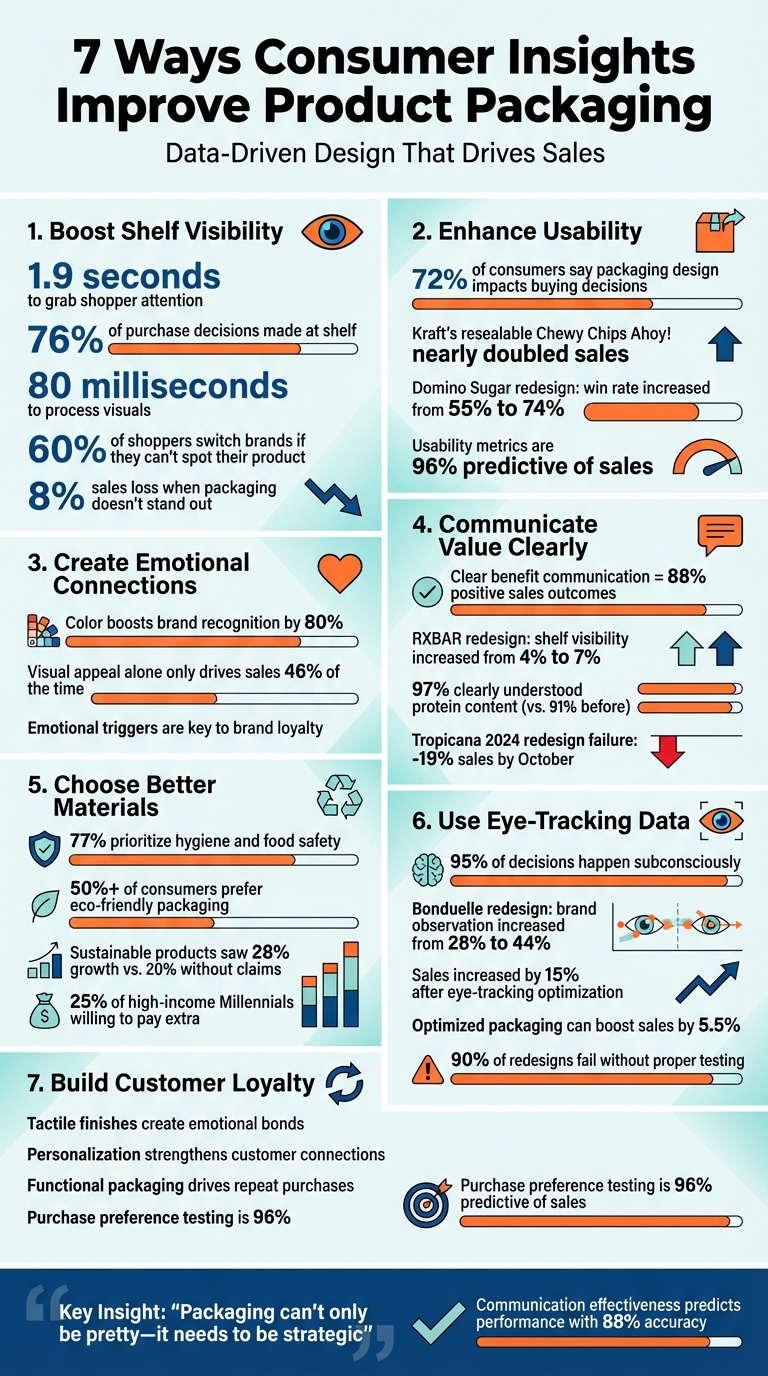
- Boost Shelf Visibility: Shoppers take only 2 seconds to notice a product. Using bold colors and testing designs with AI tools ensures your product stands out.
- Enhance Usability: Packaging that’s easy to open, pour, or reseal can double sales, as seen with Kraft’s Chewy Chips Ahoy! redesign.
- Create Emotional Connections: Elements like colors, fonts, and imagery evoke feelings that influence purchases. For example, nostalgia or modernity can shape consumer trust.
- Communicate Value Clearly: Highlight key benefits like durability or protein content to drive purchases. Overloading packaging with information can confuse shoppers.
- Choose the Right Materials: Balance hygiene, safety, and eco-friendliness. Over 50% of consumers prefer eco-friendly packaging and are willing to pay more for it.
- Use Eye-Tracking Data: Eye-tracking reveals what grabs attention, helping brands refine designs. Optimized packaging can increase sales by up to 5.5%.
- Build Customer Loyalty: Features like resealable closures, tactile finishes, and personalized designs encourage repeat purchases.
7 Consumer Insights That Transform Product Packaging Performance
1. Increase Shelf Visibility
Your packaging has just 2 seconds to grab a shopper’s attention. That’s not a lot of time to make an impression. And here’s the kicker: 76% of purchase decisions are made right at the shelf, not before the shopper even walks into the store. If your product doesn’t stand out instantly, it’s likely to go unnoticed. This is where data-driven packaging design can make all the difference.
One of the most effective tools? Color. Shoppers process visuals in as little as 80 milliseconds. Bold, contrasting colors can cut through the visual clutter and grab attention faster than anything else. A great example? Back in 2018, Coca-Cola revamped its Diet Coke packaging with slimmer, taller cans and vibrant colors to make the product pop on crowded shelves. The takeaway? Use contrast wisely. Bright, eye-catching colors can help your product stand out, especially when surrounded by similar-looking items - a phenomenon researchers call "visual flattening".
But here’s something you might not have thought about: shoppers don’t always approach shelves head-on. Most walk at diagonal angles, so your packaging needs to be recognizable from the side as well as the front. A misstep here can be costly. For instance, when Tropicana ditched its iconic design in 2009, shoppers couldn’t immediately identify it. The result? A 20% drop in sales in just two months. They quickly reverted to the original design. This highlights the importance of testing your packaging from multiple perspectives.
"The product the eye identifies first often becomes the product the shopper ultimately handles." - Tobii Pro
Modern AI tools can even predict how noticeable your product will be on the shelf. These "noticeability scores" take into account factors like shelf position, lighting, and proximity to competitors. It’s worth noting that blending in can cost brands dearly - some lose up to 8% of sales when their packaging fails to stand out. And if shoppers can’t quickly spot their preferred product, 60% will switch to a competitor. Testing your design alongside competitors, rather than in isolation, ensures your product doesn’t just fade into the background.
sbb-itb-0c3a5ed
2. Improve How Consumers Use the Package
Packaging isn’t just about catching someone’s eye on the shelf - it has to work smoothly in everyday life. In fact, 72% of consumers say packaging design impacts their buying decisions. If your product is hard to open, pour, or reseal, customers might turn to your competitors. Real-world examples show how usability issues can make or break a product.
Take Kraft's Nabisco brand as an example. Back in 2007, they added a resealable opening to Chewy Chips Ahoy! cookie bags after learning that customers were transferring cookies to other containers to keep them fresh. That small tweak had a huge payoff - it nearly doubled sales. Similarly, Domino Sugar revamped its packaging, switching from paper bags to rigid plastic containers. Even though they reduced the package size from 5 lb to 4 lb, the new design, which was easier to open and reseal, increased the perceived value. The average price jumped from $2.96 to $3.38, and their win rate against competitors soared from 55% to 74%.
But here’s the thing: how consumers actually use packaging can differ from how designers imagine it. Ethnographic research often uncovers these surprises. For instance, someone might pour coffee creamer while standing at a counter rather than sitting at a table. If the package isn’t designed with that in mind, it can lead to spills and frustration. For certain products, there’s also something researchers call the "Discretion Divide" - some people prefer packaging that’s subtle enough to leave out in plain sight without feeling embarrassed.
To avoid these pitfalls, testing prototypes with your target audience is crucial. Imagine seniors struggling with tiny tabs on hearing aid battery packages. Redesigning those tabs for easier use not only improves accessibility but also enhances customer satisfaction and sales. And when usability insights are applied, the results speak for themselves - purchase preference metrics, which are 96% predictive of sales, show a direct link between better design and revenue growth.
3. Create Emotional Connections with Your Brand
Packaging has a unique way of sparking emotional connections through something called "sensation transference." This concept suggests that elements like colors, fonts, and imagery can communicate whether your brand feels trustworthy, cutting-edge, or modern. However, even packaging designs that align with ideal aesthetics can miss the mark if they fail to evoke the right emotions on the shelf. That’s why understanding consumer insights is so crucial.
Qualitative research, such as focus groups and one-on-one interviews, digs into the "why" behind emotional responses. These insights guide every design choice - whether it’s picking the perfect imagery or fine-tuning typography. Take the example of a personal lubricant brand. Researchers uncovered what they called the "Discretion Divide." Some customers wanted packaging subtle enough to sit on a nightstand without drawing attention, while others viewed the design as an opportunity for bold self-expression. The final design struck a balance, catering to both privacy-minded and expressive consumers.
Interestingly, overall "likability" or visual appeal only translates to increased sales about 46% of the time. A beautiful package isn’t enough; you need to pinpoint the emotional triggers that truly resonate with your audience. Ethnographic research - observing how people interact with products in real-life settings - can uncover these triggers. For instance, if your coffee creamer is most often used during a rushed morning at the kitchen counter rather than a leisurely breakfast, understanding that context allows you to design packaging that fits into those moments seamlessly. Just as usability and visibility influence purchasing decisions, the emotions your packaging evokes play a key role in fostering brand loyalty.
Once you’ve identified these emotional drivers, design elements like color and typography can amplify the connection. Color alone can boost brand recognition by up to 80%. Fonts also tell a story: a classic serif font like Times New Roman conveys reliability and tradition, while a sleek sans serif like Helvetica feels modern and fresh. Imagery matters too. A realistic photo of a creamy bowl of ice cream or a steaming cup of coffee can create a stronger emotional pull than abstract visuals. And if your design leans into nostalgia, make sure those "timeless" elements still feel relevant in today’s world.
4. Communicate Product Value More Clearly
While an attractive design might catch a shopper's eye, it’s not enough to seal the deal. In fact, only 46% of visually appealing designs lead to purchases. On the other hand, clearly communicating a product’s benefits can boost positive sales outcomes by a striking 88%. Simply put, your packaging needs to do more than look good - it has to speak to the shopper.
The window of opportunity to make an impression is incredibly short. Research shows that focusing on key attributes - like "moisturizing" for soap or "durability" for tools - can drive purchase decisions. Trying to cram too many benefits onto your packaging? That’s a surefire way to confuse consumers and lower purchase intent.
Consider RXBAR's A.M. breakfast bar line. By redesigning its packaging to better highlight product value, the brand increased its first-choice shelf visibility from 4% to 7%. Even more impressive, 97% of respondents said the new design clearly communicated protein content, compared to 91% with the old design. On the flip side, Tropicana’s 2024 PET bottle redesign, which lacked adequate consumer testing, led to serious sales declines - down 8.3% in July, 10.9% in August, and a steep 19% by October 2024.
Words aren’t the only way to communicate value - visual cues matter just as much. For instance, Lactaid swapped a small vanilla cone graphic for a large, realistic bowl of cookies-and-cream ice cream on its tablet packaging. This simple change made it easier for shoppers to connect the product with taste and flavor. Similarly, Crest 3D White features the claim "removes 80% of surface stains" prominently on its packaging, helping it dominate the "whitens my teeth" category. In functional categories like healthcare or personal care, clear, results-driven claims consistently outperform vague branding.
To make sure your design hits the mark, use forced-choice testing rather than generic "like" or "dislike" surveys. This approach pinpoints which elements - like "strength" or "freshness" - resonate most. And always test branded prototypes. Unbranded packaging often gets mistaken for generic store brands, skewing perceptions of value.
5. Choose Better Materials Based on Consumer Preferences
When it comes to choosing materials, understanding consumer preferences is key. People care about usability, emotional connections, and, of course, how packaging reflects product quality. For example, 77% of US consumers rank hygiene and food safety as the most important factors for packaging, while only 43% prioritize environmental impact. This doesn’t mean sustainability is irrelevant - it just means your material choices need to strike a balance. Food safety and longer shelf life often take precedence, but ignoring eco-friendly options could be costly. Products that highlight sustainability claims saw an average growth of 28% over five years, compared to 20% for those without such claims.
Understanding what "sustainable" means to your audience is crucial. Globally, recyclability stands out as the most recognized and appreciated sustainability feature. That said, perceptions vary widely by region. For instance, in countries like Germany and Japan, where collection rates exceed 80%, PET bottles are seen as sustainable. In contrast, with the US’s much lower 33% collection rate, PET bottles are often viewed as less eco-friendly.
Material quality also plays a big role in shaping brand perception. Premium products wrapped in low-quality packaging can undermine the brand's image, as consumers expect the packaging to reflect the product’s value. On the flip side, more than 50% of consumers who prefer eco-friendly options are willing to pay extra, with that number rising to 25% among high-income Millennials in markets like Germany.
"Consumers view brand owners and packaging producers - rather than themselves, retailers, or regulators - as responsible for driving sustainability in packaging." - McKinsey & Company
Functionality is another critical factor when selecting materials. Testing new options like compostable films or fiber-based alternatives requires more than just shelf appeal. In-home usage tests can reveal how well these materials perform in real-life scenarios. After all, a package that looks great in the store but fails to reseal properly at home could frustrate users and hurt the overall experience.
6. Test and Refine with Eye-Tracking Data
Eye-tracking technology offers a powerful way to understand and refine how shoppers interact with packaging. While intuition might guide initial designs, it can't reveal the precise details of what grabs attention on the shelf. Eye-tracking fills this gap by showing exactly where consumers look, how long they focus on specific elements, and what they might overlook. This is crucial, considering that about 95% of decision-making happens subconsciously. With this data, designers can make informed changes to improve both visibility and usability.
Key metrics like "time to first fixation" and "dwell time" provide insights into how quickly and how long consumers focus on key packaging elements. Heatmaps further illustrate "hot spots" of attention and map the path a shopper’s eyes take across the design. For example, when Bonduelle evaluated their ready-made salad packaging, they discovered their brand observation rate was just 28%. After redesigning the packaging with a "funnel" shape to guide visual focus, the brand observation rate increased to 44%, and sales rose by 15%.
The practical value of eye-tracking is clear:
"Using eye tracking gives you the opportunity to look through the consumer's eyes, so instead of only listening to an opinion we now see the analysis… and when we need a specific answer to a question, we use a lot of eye tracking because eyes don't lie." - Jeroen van der Kallen, Customer Insight and Innovation Manager Europe, Unilever
Eye-tracking can also catch design flaws before products hit the shelves. For instance, one analysis revealed a logo's visibility dropped from 15% to 2%, which led to a 20% decline in sales. Testing your packaging in realistic settings - whether virtual or physical - is critical, especially since 90% of package redesigns fail to deliver meaningful sales improvements.
To keep designs effective, research suggests focusing on no more than three key elements to avoid overwhelming the shopper. High-contrast designs also make essential details stand out. These data-driven refinements can lead to tangible results, with optimized packaging boosting forecasted sales volumes by up to 5.5%. Eye-tracking doesn’t just improve visual appeal - it drives real sales growth.
7. Increase Customer Loyalty and Repeat Purchases
Packaging isn’t just about making a great first impression - it plays a key role in keeping customers coming back. By understanding what design features resonate with shoppers, brands can turn a single purchase into an ongoing relationship.
The look and feel of packaging have a direct impact on repeat purchases. Features like soft-touch coatings, embossing, and foil stamping create a luxurious tactile experience that can form an emotional bond with consumers. On the visual side, using realistic imagery to highlight benefits - like showcasing freshness or delicious flavors - can leave a stronger impression than text-heavy claims. When customers can see the value of a product, it sticks in their minds and makes them more likely to pick it up again.
Tracking how packaging influences repurchase decisions is essential. Tools like post-purchase surveys can reveal whether packaging played a role in a customer’s decision to buy again. Eye-tracking studies can also show if features like resealable closures or sustainability certifications catch shoppers’ attention. With these insights, brands can refine their designs to build loyalty even further.
Personalization is another powerful way to strengthen customer connections. Limited editions or customized labels can make shoppers feel special and appreciated. At the same time, minimalist designs - by focusing on simplicity and quality - can help your product stand out.
Functionality can’t be overlooked either. Studies like diary entries and in-home tests show that practical packaging features matter. If a package is hard to open or doesn’t reseal properly, even the best product inside might not win a second purchase. User testing consistently shows that well-designed, functional packaging keeps customers loyal over the long haul.
In short, thoughtful, consumer-driven packaging design isn’t just about aesthetics - it’s a strategic tool for building lasting relationships with your customers.
Conclusion
Packaging isn’t just a container - it’s a sales tool that can make or break a product’s success. The seven methods discussed here, from boosting shelf appeal to fostering customer loyalty, all revolve around one key principle: keeping the shopper at the heart of every design choice. When brands understand what grabs attention, communicates value, and builds emotional connections, packaging evolves into more than just protection for the product - it becomes a driver of sales.
Research backs this up. Purchase preference testing is 96% predictive of sales outcomes, while communication effectiveness predicts real-world performance with 88% accuracy. As Designalytics puts it:
"Not only does it not matter if the brand owner finds a design aesthetically appealing, it doesn't seem to matter much whether consumers en masse do... packaging can't only be pretty - it needs to be strategic too".
These numbers highlight why consumer insights are essential in every design phase. PKG Brand Design’s Consumer First® approach leverages Nielsen’s BASES factors - Catch Attention, Connect Message, and Communicate Clearly - to ensure packaging truly resonates with shoppers.
If you’re ready to apply these insights, check out our pricing plans tailored to fit every CPG company’s needs:
- Starter Plan ($5,000+): Includes 2 packaging concepts and 2 rounds of revisions.
- Basic Plan ($12,000+): Offers 2 logo concepts, 3 packaging concepts, 2 rounds of revisions, and a consumer eye-tracking test.
- Premium Plan ($20,000+): Features 4 logo concepts, 4 packaging concepts, 3 rounds of revisions, eye-tracking, and an in-depth package research study.
Great packaging design isn’t about following trends - it’s about meeting your shopper’s exact needs. By testing, refining, and iterating based on real feedback, you’ll create packaging that delivers measurable results where it matters most: in the hands of your customers.
FAQs
How do consumer insights improve product packaging design?
Understanding what customers truly want and expect is key to improving product packaging. By tapping into consumer insights - like preferences, behaviors, and buying habits - brands can craft visually appealing designs that not only catch the eye but also create an emotional connection. This kind of thoughtful design fosters trust and brand recognition, especially in crowded markets.
Consumer insights also help make packaging more practical. Features like ease of use, convenience, and environmentally friendly materials are increasingly important to today’s buyers. Research and testing allow brands to refine their designs, ensuring they align with customer expectations while minimizing risks. When done right, packaging becomes more than just a container - it strengthens the bond between the product and its audience, helping it stand out, build loyalty, and ultimately drive sales.
How does eye-tracking data help improve product packaging?
Eye-tracking data offers an insightful way to understand how consumers interact with product packaging. By tracking where people look in real time, it reveals which design elements grab attention first, whether important product details stand out, and how well the packaging conveys the brand's message.
This technology uncovers subtle visual behavior, giving designers the tools to fine-tune packaging for greater shelf appeal, stronger brand visibility, and an edge in crowded retail environments. The result? Packaging that doesn’t just look appealing but also resonates with shoppers and influences their buying decisions.
Why is building an emotional connection important in product packaging?
An emotional bond through packaging design plays a big role in shaping how consumers perceive and interact with a brand. When packaging mirrors a brand's core values and aligns with what customers care about, it builds a sense of trust and familiarity. This connection often translates to loyalty, as shoppers are more inclined to pick a product they feel comfortable with time and time again.
Packaging that stirs positive feelings or taps into cherished memories can deepen this attachment. In crowded retail environments, such emotional resonance helps a product stand out and feel more personally meaningful to the buyer. By creating this kind of connection, packaging not only enhances the shopping experience but also strengthens trust and encourages lasting brand loyalty.