

Emerging markets are a growth goldmine for CPG brands. With over 4.3 billion people and driving 50% of global GDP growth in the last decade, these regions are set to fuel 60% of global retail growth. But succeeding here requires more than just expanding - it's about understanding local consumers, navigating fragmented retail networks, and tailoring products to meet unique market needs.
Key Takeaways:
- Market Potential: Focus on regions with growing middle classes, urbanization, and high digital adoption, like Asia-Pacific, Africa, and Latin America.
- Local Research: Use tools like PESTLE and fieldwork to understand consumer habits, cultural nuances, and competitor strategies.
- Product Customization: Adjust product formulas, packaging (e.g., smaller sizes), and branding while keeping global identity intact.
- Distribution Challenges: Build partnerships with local distributors to tackle fragmented retail channels and delivery complexities.
- Marketing Focus: Leverage social media, influencers, and hyper-local campaigns to connect with consumers.
Emerging markets offer immense opportunities for brands willing to adapt their strategies and invest in understanding local dynamics.
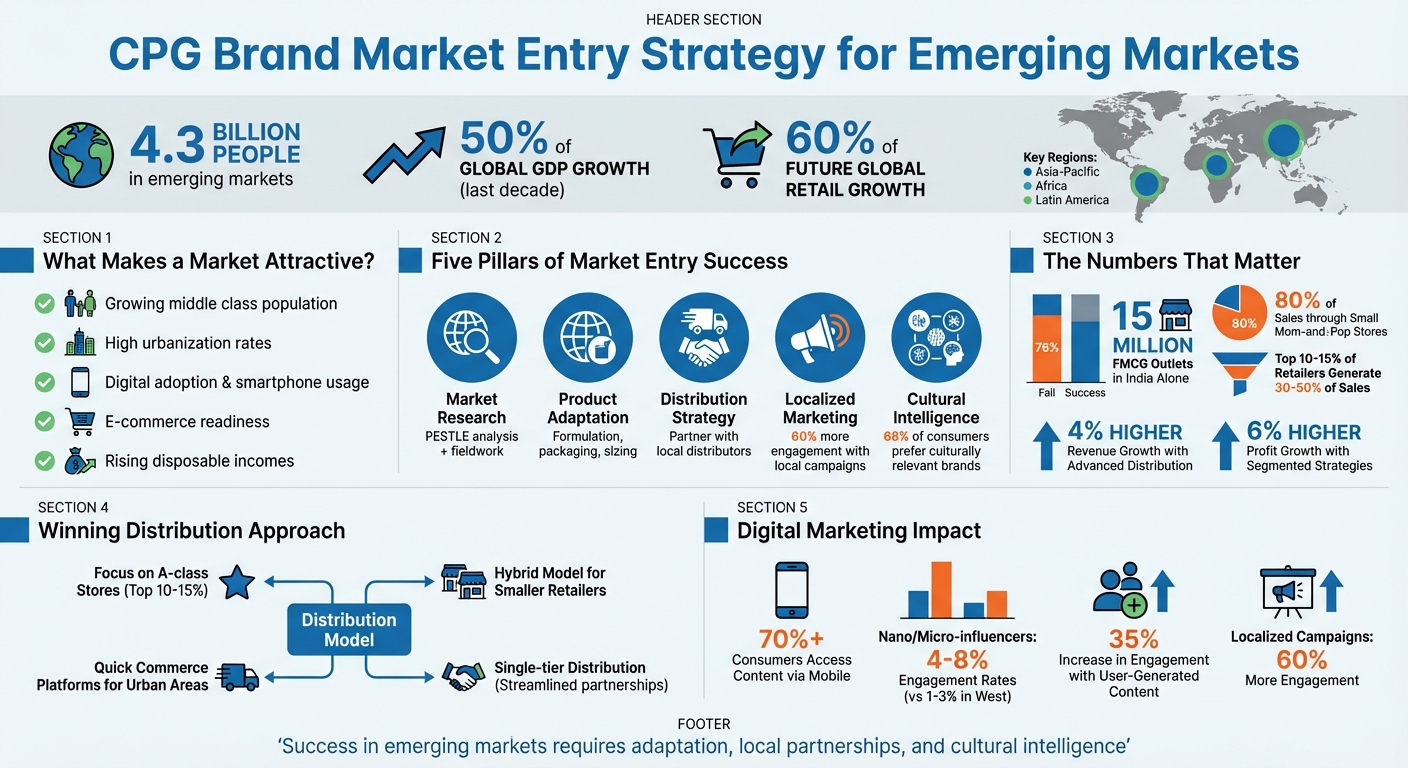
CPG Brand Market Entry Strategy: Key Statistics and Success Factors for Emerging Markets
Assessing Market Potential and Feasibility
Determining if an opportunity is worth pursuing requires more than just looking at population statistics. It’s about digging into the economy, understanding consumer readiness, and evaluating operational realities.
Identifying High-Growth Regions
A detailed market assessment is essential for tailoring products and branding to emerging markets. These regions differ widely in their potential. Areas like Asia-Pacific, Southeast Asia, Africa, and Latin America offer unique opportunities, each powered by distinct growth drivers. To succeed, focus on regions where factors like demographic shifts, urbanization, and digital adoption align with your product’s strengths.
Urbanization is a key signal of concentrated demand. As people move from rural areas to cities, they gain exposure to modern retail and brands through media. Midtier cities, in particular, often have untapped demand and less competition, making them attractive targets for expansion.
Digital adoption is another critical factor. High smartphone and internet usage indicate a market’s readiness for e-commerce. In regions where platforms like Blinkit and Zepto operate, brands can bypass traditional infrastructure challenges, reaching consumers in as little as ten minutes.
Population growth matters, but the market’s composition is just as important. A growing middle class and brand-conscious consumers often drive demand for branded products and openness to new offerings. For example, in Latin America, the beauty market reached $8.9 billion in 2024, while the pet food sector hit $2.4 billion - both fueled by lifestyle changes and rising disposable incomes.
Evaluating Market Attractiveness
After identifying promising regions, the next step is to assess whether your brand can compete effectively. This requires analyzing five key areas: economic indicators, retail infrastructure, regulatory environment, competitive landscape, and your own operational readiness.
Economic metrics lay the groundwork. GDP growth rates, middle-class expansion, and shifting purchasing habits are all indicators of a market transitioning from price-sensitive to brand-conscious behavior. This shift creates opportunities for new players to establish themselves before competition heats up.
Retail infrastructure shapes your ability to penetrate the market and manage costs. Understanding the balance between modern trade (like hypermarkets) and general trade (small, independent stores) helps estimate the complexity of distribution and the investment needed. In many emerging markets, fragmented retail networks dominate.
"The go-to-market approach for emerging markets can be dizzyingly complex, with fragmented distribution and a wide range of retail formats and channels - from big-box stores to independent mom-and-pop outlets." – BCG [3]
The regulatory environment is another critical factor. Local product standards, import restrictions, labeling rules, and compliance requirements can significantly affect your timeline and costs. Many brands underestimate these hurdles, contributing to the 76% failure rate of new product launches each year.
Microsegmentation is what sets successful entrants apart. Treating an entire country as a single market often leads to missed opportunities. Instead, segment by city tier, demographics, income levels, and social media behavior. This approach allows you to identify high-potential "micro-markets" where you can focus efforts initially and build momentum. Companies in India and Southeast Asia that adopt well-segmented strategies outperform their competitors by about 4% in annual revenue growth and 6% in profit growth.
Finally, leverage local market research to gather detailed insights and fine-tune your strategy for success.
sbb-itb-0c3a5ed
Conducting Local Market Research
After identifying a promising market, the next step is to dig deep into understanding your potential customers and the competition. This involves examining consumer behavior, local customs, and competitor strategies to create a clear picture of the market landscape.
Start with a mix of secondary research and fieldwork. Desk research tools like the CIA World Factbook and Hofstede Insights can offer valuable insights into macro trends, regulations, and cultural dynamics. Applying the PESTLE framework helps assess factors like political stability, economic conditions, and legal challenges that could influence your market entry. This initial research provides a high-level understanding of the environment before you commit significant resources.
But don't stop there. Frameworks alone won't reveal why people prefer one brand over another or how competitors thrive at the grassroots level. That's where field research comes in. By gathering detailed consumer and competitor insights, you can fine-tune your product offerings and strategies to align with local expectations.
Analyzing Consumer Segments and Behavior
To truly understand your customers, you need to go beyond basic demographics like age or income. Dive into psychographics - values, aspirations, and daily habits - to uncover what drives their purchasing decisions. In emerging markets, factors like family roles, education, and social norms often outweigh income in shaping brand preferences.
Ethnographic research can be a game-changer. Observing shoppers in their natural environments and speaking directly with shopkeepers can reveal which brands are flying off the shelves and why. These insights can also help identify promotions that resonate with local audiences.
Cultural considerations are equally crucial. In some regions, families make collective purchasing decisions, while in others, price sensitivity or availability may dictate brand loyalty. Religious practices, color significance, and even packaging sizes can heavily influence whether your product succeeds or fails.
"The difference between international expansion success and failure often comes down to one factor: how well you understand your target markets before you invest serious money in them." – EC Innovations [6]
These insights form the backbone of tailoring your brand, packaging, and messaging to fit local tastes and expectations.
Studying Local Competitors
Understanding your competition in emerging markets requires a tailored approach. You're not just competing with global brands but also with local players who often have a deep understanding of the market.
Classify competitors into three groups: direct (offering the same products to the same customers), indirect (different products addressing similar needs), and substitutes (alternative solutions). Local brands often thrive by offering "good-enough" quality at lower prices, leveraging local suppliers to keep costs down.
Distribution is a key battleground. In markets like India, where millions of small retailers dominate the consumer goods sector, competition often hinges on how well companies serve these fragmented channels. Consider factors like offering credit to retailers, restocking frequency, and securing prime shelf space.
Gather intelligence by speaking directly with retailers to learn about competitor pricing, stock levels, and promotional strategies. Monitor local e-commerce platforms and social media to spot gaps in competitors' offerings. Tools like Porter's Five Forces can help assess market dynamics, such as supplier power and the risk of substitutes.
Beyond categorizing competitors, dive into measurable performance indicators to identify strategic opportunities. Look at market share, sales growth, and brand awareness compared to your key rivals. For example, consumer goods companies with more advanced distribution strategies in India and Southeast Asia outperform their competitors by 4% in annual revenue growth and 6% in profit growth. By understanding how these companies excel - whether through pricing, distribution, or retailer partnerships - you can identify ways to carve out your own success.
Take Vietnam as an example. Between 2005 and 2009, Masan Consumer grew its market share in the table sauce category from 2% to 36%. They achieved this by transforming unbranded, traditional products into a cohesive brand with their Nam Ngu sauce line. Instead of creating something entirely new, they capitalized on local tastes and executed their strategy flawlessly at the retail level.
Adapting Products and Brand Strategy for Local Markets
Once local market research is complete, the next step is tailoring products and messaging to meet regional preferences. The challenge is to adapt while maintaining a strong global identity.
The secret lies in balancing "core" and "flex" elements. Core elements - like your logo, signature colors, and iconic shapes - should remain consistent worldwide to protect brand recognition. Flex elements, on the other hand, such as packaging, promotional messaging, and certain visual details, can be adjusted to suit local tastes. A great example is Toblerone, which keeps its triangular shape and gold color globally but customizes packaging sleeves for events like Diwali in India, Chinese New Year in China, or city-specific designs in Zurich and Barcelona. These thoughtful adjustments, guided by market research, help brands connect locally without losing their global identity.
Beyond Surface-Level Changes
Adapting products isn’t just about tweaking appearances. In emerging markets, it often requires rethinking the product itself - its formulation, functionality, and even packaging size. Take Procter & Gamble, for instance. When designing diapers for emerging markets, they set a goal: each diaper couldn't cost more than the price of an egg. This forced designers to innovate with materials and packaging, ensuring affordability without sacrificing quality. Similarly, Nokia worked with local designers to create phones tailored to specific markets, such as dust-resistant models with built-in flashlights for rural India and touchscreens with Chinese character recognition for China.
Customizing Packaging Design
Packaging design plays a huge role in connecting with local consumers. In emerging markets, where small kiosks and corner stores dominate, brands often need smaller, more affordable pack sizes or single-use sachets instead of bulkier, economy-sized options. This trend, often called "sachetization", allows consumers with limited or irregular incomes to enjoy premium products without a big upfront cost.
But it’s not just about size. Packaging also needs to fit the local retail environment and cultural expectations. In areas with challenging retail conditions, packaging must be durable and highly visible. Sometimes, it even doubles as a storage container or toy, adding extra value for budget-conscious buyers. Cultural considerations are equally important. For example, when Mondelēz International introduced Milka chocolate in China, they initially planned to use gold packaging to signal premium quality. However, research revealed that a pale, yellowish-gold shade was associated with death in Chinese culture. This insight led to the creation of a unique gold hue specifically for the Chinese market.
"A GloCal (Global-Local) mindset should be an essential component in any global design and packaging plan, requiring proper due diligence, to carefully understand the local market context and consumer needs." – Gil Horsky, Innovation Platform Lead, Mondelēz International [8]
PKG Brand Design’s Consumer First® approach helps brands navigate these challenges by integrating local consumer insights into the design process. Tools like consumer eye tracking and package research studies ensure that packaging resonates with local audiences while preserving global brand equity. This reduces the risk of costly mistakes when entering new markets.
Balancing Global and Local Branding
Striking the right balance between global and local branding means staying true to your brand's core identity while tailoring other elements to fit local preferences. The most successful brands maintain their core values and promises across markets but adapt things like language, cultural references, and promotional strategies to connect with local audiences. For instance, Ford’s misstep in reducing features for its Indian model highlighted the importance of aligning product changes with local expectations.
Pre-launch workshops with local sales teams can help audit visual cues and spot potential cultural taboos, such as inappropriate colors, shapes, or claims. Collaborating with local designers is another smart move, as it can prevent costly redesigns and foster authentic connections with consumers.
Developing Market Entry and Distribution Plans
Once products have been tailored to local preferences and brand messaging is on point, the next big hurdle is ensuring a smooth market entry with a strong distribution plan. In emerging markets, this is easier said than done. The retail environment is often fragmented, infrastructure can be unreliable, and the rules of the game are vastly different from those in developed regions.
Choosing Distribution Channels
Emerging markets can be a maze of retail options. Take India, for example, where over 15 million fast-moving consumer goods (FMCG) outlets operate, or the Philippines, which has around 1.4 million stores across seven retail channels. In both cases, small mom-and-pop stores and kiosks dominate, accounting for up to 80% of sales. These smaller retailers often require frequent restocking in small quantities, which makes distribution a real challenge. The question is: how do you effectively and profitably reach millions of these small-scale retailers?
"The go-to-market approach for emerging markets can be remarkably complex, with fragmented distribution and a wide range of retail formats and channels - from big-box stores to independent mom-and-pop outlets." – Amit Mittal, Partner and Associate Director, BCG [3]
The key lies in segmentation. Successful brands focus on the top-performing 10–15% of retailers - commonly referred to as "A-class" stores - that typically generate 30–50% of total sales. These high-performing outlets are prioritized with frequent visits, dedicated displays, coolers, or even in-store promoters. For smaller, lower-volume retailers, a hybrid approach works best. This might include a mix of physical visits and digital tools, such as mobile apps that allow retailers to place orders directly. Meanwhile, quick commerce platforms like Blinkit and Swiggy Instamart are shaking things up by offering ultra-fast delivery in urban areas, opening up new ways to reach customers.
Once the distribution channels are mapped out, the next step is to build strong local partnerships to tackle ground-level challenges.
Forming Local Partnerships
Even with a solid distribution plan, local partnerships are essential for navigating the complexities of emerging markets. Local distributors and channel partners bring something invaluable - deep market knowledge and established relationships - that multinational companies often lack. A great example of this is Coca-Cola's 2005 acquisition of Russian juice maker Multon through its subsidiary Hellenic Bottling. This move helped Coca-Cola tap into local juice preferences and led to a 7% sales boost across North Asia, Eurasia, and the Middle East. Similarly, Procter & Gamble invested $40 million in a fleet of vehicles in Russia to ensure consistent deliveries to open-air market stalls, overcoming logistical hurdles. In India, Kellogg's found success in the mid-1990s by introducing Chocos breakfast biscuits at an affordable price of 10 cents for a 50-gram pack, distributing them through roadside tea stalls to reach mass-market consumers.
Choosing the right partners requires a careful evaluation of their infrastructure and capabilities, such as sales teams, capital resources, and warehouse capacity. Many companies streamline their operations by adopting a single-tier distribution model, which offers better control. For instance, one global consumer packaged goods firm cut its partner network from 1,000 to 500, boosting the efficiency and revenue of its remaining channels. To keep partners motivated and aligned, companies often link up to 50% of their incentives to performance metrics like sales targets, product variety, and market expansion. Tools like mobile apps for billing, inventory management, and payout simulations can further enhance these partnerships, ensuring smoother execution on the ground.
Building Consumer Awareness Through Marketing and Digital Channels
After securing distribution and forming partnerships, the next big step is grabbing consumer attention and earning their trust. In emerging markets, this often means stepping away from traditional advertising and diving into digital channels. Research shows that localized marketing campaigns generate up to 60% more engagement than global, one-size-fits-all advertisements. Additionally, 68% of consumers in these markets prefer brands that genuinely reflect their local culture. The key is to connect with consumers where they are - using their language and telling stories that resonate with their experiences. Once distribution is in place, the focus shifts to engaging consumers through targeted digital strategies.
Using Social Media and Influencers
Social media is a game-changer for educating and engaging consumers, especially in emerging markets. It’s often the first point of contact for brand discovery, but the platforms people use vary by region. For instance, TikTok dominates in Southeast Asia and Africa, while Instagram Reels and WhatsApp are more popular in Latin America and India [32,33]. Notably, over 70% of consumers in countries like India and Nigeria access digital content primarily through mobile devices. This makes short, vertical videos (15–60 seconds) and mobile-friendly formats a necessity for effective outreach.
Choosing the right platform is just the start. To make a real impact, brands are increasingly working with influencers who align with their target audience. Instead of big-name celebrities, nano-influencers (1,000–10,000 followers) and micro-influencers (10,000–100,000 followers) often deliver better results in these markets. In Southeast Asia, for example, these influencers boast engagement rates of 4–8%, far higher than the 1–3% typically seen in Western markets. Plus, they’re budget-friendly, with posts costing between $100 and $500.
Real-world examples highlight how this approach works. Coca-Cola’s “Share a Coke” campaign in Africa personalized bottles with local names and encouraged user-generated content on Facebook and Twitter. The result? A 20% sales increase in just three months. Similarly, Alibaba’s partnerships with local influencers in Southeast Asia led to a staggering 300% growth in active users within a year.
Creating Locally Relevant Campaigns
Generic, cookie-cutter campaigns don’t cut it in emerging markets. Hyper-localized efforts - where brands collaborate with local artists, photographers, and influencers - ensure that messaging and visuals reflect the region’s unique identity. This isn’t just about translating content; it’s about adapting every aspect, including imagery and even color choices, to align with local traditions. For instance, in some Asian cultures, the color white is linked to mourning, so its use in celebratory campaigns requires caution. User-generated content that tells local stories can further boost annual engagement by 35%.
Localization has proven its worth time and again. In 2022, Spotify launched a campaign in India during the Indian Premier League season, creating 15 videos in Hindi that combined local language with culturally relevant scenarios. The campaign reached audiences in 195 countries through region-specific playlists and ads. Another example is Indofood’s Indomie brand in Nigeria, which paired consumer education with localized distribution strategies to capture a dominant 60% market share by 2023.
The lesson is simple: authenticity matters. By teaming up with local talent, creating adaptable content, and using feedback loops to refine their approach, brands can foster trust and long-term engagement in emerging markets.
Conclusion
Expanding into emerging markets isn’t about applying a universal strategy - it’s about understanding the unique dynamics of each market. Success begins with thorough market research to identify consumer needs, assess competition, and gauge growth opportunities. Skipping this step can lead to critical missteps, like overestimating demand or setting prices beyond what local consumers can afford. This research phase lays the groundwork for everything else, from tailoring products to refining distribution strategies.
Adapting products and brands to local preferences is just as important. This might involve tweaking product formulations, resizing packaging to match local budgets, or ensuring compliance with regional regulations. These adjustments are essential for aligning with local expectations and building trust with consumers.
Local partnerships and distribution networks are another key piece of the puzzle. These connections bring invaluable insights and infrastructure, especially in fragmented retail environments where small, traditional shops can account for as much as 80% of sales. Without these partnerships, navigating such markets can be a daunting challenge.
Finally, packaging design ties all these elements together. Services like PKG Brand Design specialize in creating packaging that balances global branding with local appeal. Through their Consumer First® approach, they incorporate regional insights to ensure packaging aligns with local aesthetics, complies with regulations, and fits within cost expectations. With 76% of annual product launches failing - often due to poor alignment with market needs - getting the packaging right from the start is essential. By combining deep research, tailored product strategies, and strategic partnerships, PKG Brand Design helps brands create packaging that resonates both locally and globally.
FAQs
How do I pick the right emerging market to enter first?
To choose the right emerging market, start by diving deep into factors such as consumer demand, market readiness, and how well the market aligns with your brand's identity. Take a close look at potential challenges like regulatory barriers, operational expenses, and the market's growth trajectory. Focus on markets that show strong promise for long-term success by studying consumer behavior and tailoring your strategies to address local preferences and needs effectively.
What should I localize in my product without losing my brand?
To tailor your product for local markets without sacrificing your brand identity, adjust aspects like packaging, product sizes, formulations, and messaging to align with local tastes and habits. For instance, offering smaller packaging might appeal to regions with different purchasing patterns, or you could tweak formulations to match local ingredient preferences or price expectations.
However, it's important to keep your core brand elements intact - such as your logo, overall identity, and main messaging. This ensures your brand remains consistent and recognizable no matter the market.
How can I reach mom-and-pop stores profitably?
To successfully engage mom-and-pop stores in emerging markets, it's essential to adopt a segmented strategy that caters to their specific needs. This means creating tailored plans for distribution, merchandising, and support, taking into account factors like the store's size, location, and target customers. By offering personalized service and flexible options, you can build strong relationships with these businesses. This approach not only helps you navigate growing competition but also ensures profitability, even when margins are tight.