---
title: Multisensory Packaging and Brand Loyalty
description: How touch, scent, sound and visuals in packaging build emotional bonds, increase repeat purchases, and when balanced, avoid sensory overload.
image: https://assets.seobotai.com/cdn-cgi/image/quality=75,w=1536,h=1024/pkgbranding.com/699e3f7cefc60cc2af09b0fd-1771990125261.jpg
---
[ ](https://www.pkgbranding.com/)
[ ](https://www.hangar-12.com/)
[312.870.9101](tel:+1.312.870.9101)
# Consumer First Insights
## How Multisensory Packaging Impacts Brand Loyalty
Written by Kevin Keating at PKG
**Multisensory packaging isn’t just about looks - it’s about creating emotional connections that keep customers coming back.** By engaging multiple senses like touch, scent, and sound, brands can strengthen loyalty and influence purchase decisions.
Key takeaways:
- **First impressions matter:** Packaging is often the first interaction with a brand, shaping perceptions instantly.
- **Multiple senses = stronger loyalty:** Consumers are twice as likely to stay loyal when exposed to multisensory packaging.
- **Science supports it:** 75% of emotions are linked to scent, and even small tactile details can boost purchase intent by up to 90%.
- **Real-world examples:** Apple’s packaging design helped it achieve a $612 billion market value, while sensory missteps, like overly noisy packaging, can alienate customers.
The secret? Align sensory elements - like textures, colors, and scents - with your brand’s identity while avoiding overstimulation. This balance creates memorable experiences that resonate with customers and drive repeat purchases.
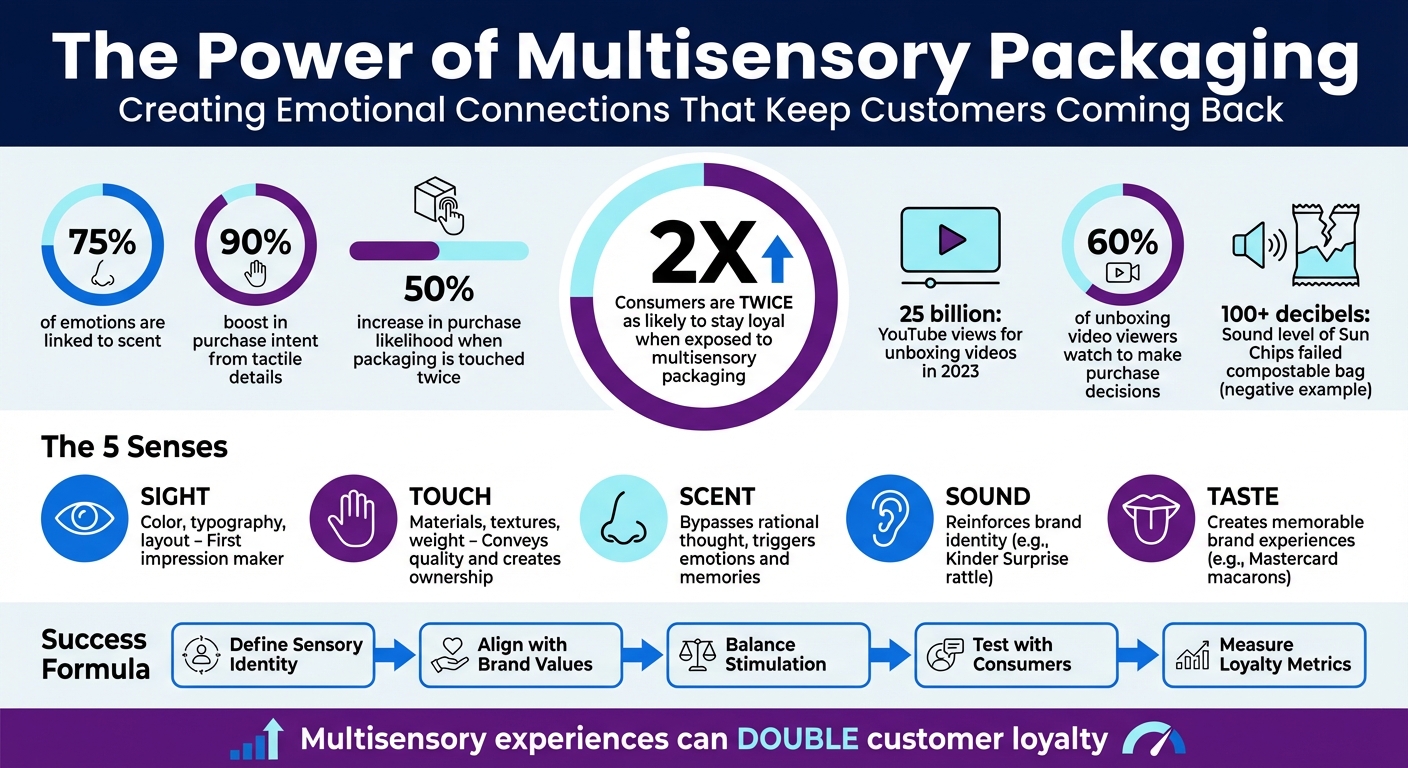
Multisensory Packaging Impact on Brand Loyalty: Key Statistics and Benefits
## The Science Behind Multisensory Packaging and Brand Loyalty
### How the Brain Processes Sensory Information from Packaging
When you handle a package, your brain doesn’t treat each sensory input as separate - it combines them into a unified experience. This process is rooted in **embodied cognition**, where physical sensations subtly influence emotions and decisions without conscious awareness.
Each sense taps into the brain differently. Visual cues, for example, go through several layers of processing. Meanwhile, **scent takes a shortcut**, bypassing rational thought entirely to activate the limbic system, which governs emotions and memories. This is why a specific aroma can instantly remind you of a childhood moment or evoke a strong emotional connection to a brand.
The brain also craves harmony across sensory inputs, a concept researchers call "processing fluency." When the weight, texture, and design of packaging align, the brain processes the information more smoothly, fostering trust and a stronger bond with the brand. This phenomenon, known as **crossmodal correspondences**, explains why a heavier box can suggest higher quality or why darker colors on packaging might hint at a richer flavor. Professor Charles Spence from the [University of Oxford](https://www.ox.ac.uk/) refers to this as **affective ventriloquism**:
"The hedonic attributes of a product perceived via one modality (such as touch) can 'pull' (or bias) a person's estimates of the quality and pleasantness of the product derived from other sensory modalities into alignment".
Additionally, observing someone else interact with packaging can activate **mirror neurons**, creating a kind of secondhand sensory experience. This is one reason why unboxing videos have become so popular. In 2023, YouTube videos with "unboxing" in the title amassed 25 billion views, with 60% of viewers watching to decide whether to purchase the product or something similar. These neural responses explain why multisensory packaging leaves such a lasting impression.
### Research Findings on Multisensory Packaging Effects
The data clearly shows how engaging multiple senses through packaging can drive brand loyalty. For instance, handling premium packaging often triggers a sense of psychological ownership - your brain starts to feel like the product belongs to you even before you buy it.
Scent, in particular, creates instant emotional connections. However, there’s a fine line. Studies on chocolate packaging reveal that while scent can enhance the perception of luxury and boost purchase intent, overly intense scents can lead to "hedonic overload", which diminishes the overall appeal.
Real-world examples highlight how brands leverage these insights. In October 2019, Mastercard introduced macarons flavored like custard apple and Japanese yuzu at the New York Food Festival and Ladurée in SoHo. Designed to resemble the Mastercard logo, these macarons used taste and smell to create a memorable connection in an unconventional setting for a financial services brand. Similarly, in November 2023, Glossier hosted an ASMR pop-up experience in London for its "Glossier You" fragrance. Visitors engaged multiple senses through sound, tactile scented hand massages, and visual elements, deepening their emotional connection to the brand.
That said, not all sensory strategies succeed. In 2010, Frito-Lay introduced a compostable Sun Chips bag that reached sound levels over 100 decibels - so loud it triggered a negative "fight or flight" reaction in consumers. The discomfort led to a sharp drop in sales, forcing the company to pull the packaging. As design strategist Kevin Keating, President of PKG Brand Design, aptly notes:
"Tactile engagement drives conversion. Failing to inspire consumer interaction with your packaging correlates with a 50% drop in purchase intent."
###### sbb-itb-0c3a5ed
## The 5 Senses in Packaging Design
### Visual Design: Color, Typography, and Layout
The visual appeal of packaging is what grabs attention first. Colors play a huge role in shaping emotions - red might stir feelings of urgency or excitement, while blue often conveys calmness and trust. Typography adds another layer, reflecting the product's personality. For instance, bold, sharp fonts can suggest power and intensity, while softer, rounded fonts feel more approachable and friendly. A well-thought-out layout ensures that key details, like the brand name or product benefits, are easy to spot, guiding the viewer's eye and reinforcing brand identity.
But visuals are just the beginning. What you feel when you hold the package can leave an even stronger impression.
### Tactile Design: Materials and Textures
Touching a package can completely shift how a product is perceived. A heavier package often feels more luxurious - our brains naturally associate weight with quality. That’s why premium brands often use thicker materials or add weight to components like lids. Texture also plays a big role. Soft-touch coatings give off a sense of sophistication and comfort, while rougher textures can amplify the idea of "crunchiness" in snacks, a concept known as texture congruence. This physical interaction can create a sense of ownership, making the product feel like it already belongs to the consumer.
Matthew Unger, Purchasing Group Manager at Procter & Gamble, explains this perfectly:
"The way a package feels to the consumer, how 'it speaks' through touch as well as vision, is the 'moment of truth, the moment of choice'".
And it doesn’t stop at sight and touch - other senses can elevate the experience even further.
### Scent and Sound in Packaging
Smell has a unique way of creating instant emotional connections, bypassing logic entirely. Some brands now use scented varnishes that release fragrance when touched. A great example of this is the 2017 collaboration between [Sappi](https://www.sappi.com/en-us/) and [JohnsByrne](https://www.johnsbyrne.com/), which featured a gift box with pine-scented varnish. Opening the box brought out the aroma, instantly evoking cozy holiday memories.
Sound also plays a surprising role in packaging. Think of the [Kinder Surprise](https://www.kinder.com/uk/en/kinder-surprise) egg - its iconic rattle helps reinforce its playful brand identity. However, sound needs careful consideration. When Frito-Lay introduced a compostable Sun Chips bag in 2010, the excessive noise it made (over 100 decibels) turned customers away, leading to a drop in sales and the eventual discontinuation of the packaging.
## How to Implement Multisensory Packaging
### Matching Sensory Elements to Your Brand
Start by defining your brand's sensory identity - what it should feel, sound, and smell like. This alignment should reflect your brand values and resonate with your target audience. For premium products, consider adding weight to the packaging or using soft-touch finishes. Heavier packaging often conveys a sense of higher quality to consumers. For products tied to flavor, use **crossmodal correspondences** to set the right expectations: burgundy tones pair well with BBQ flavors, while darker colors suggest bitterness. This approach enhances **processing fluency**, making it easier for consumers to understand and connect with your brand when sensory elements align with their expectations.
However, avoid going overboard. Overwhelming sensory input - like an overpowering scent or overly loud packaging - can cause hedonic overload, which diminishes appeal. Striking the right balance is key. Once you’ve nailed down the sensory elements, choose materials that align with these experiences while supporting sustainability goals.
### Choosing Materials That Are Both Creative and Eco-Friendly
After refining your sensory identity, focus on materials that enhance the sensory experience without compromising eco-conscious values. You don’t need a complete packaging redesign to create impact. Instead, use **on-press finishes** like coatings and varnishes for cost-effective sensory effects. Thermochromic inks that change color with temperature, UV gloss for added depth, or multi-level embossing for a standout tactile experience can all elevate your packaging without requiring major structural changes.
For scent, consider options like scented varnishes or micro-encapsulated aromas in adhesives, which can evoke strong memory associations. As ecolabeling becomes mandatory for many companies by 2025, opt for materials that offer tactile appeal but remain biodegradable or recyclable. The challenge lies in finding the perfect intersection of creativity and environmental responsibility.
### Using Consumer Research to Guide Packaging Decisions
Consumer research is crucial to validate your sensory choices and avoid costly missteps. It helps identify the right level of sensory stimulation before production begins. **Online testing methodologies** allow you to quickly evaluate multiple design options and determine which sensory configurations align best with your brand goals. Tools like "Check-All-That-Apply" (CATA) emotion lexicons can help pinpoint the emotions - such as joy, trust, or fascination - that different textures or unboxing experiences evoke.
Research also highlights when sensory elements become overwhelming, helping you steer clear of negative reactions that could hurt sales. By incorporating these insights, you can ensure every sensory touchpoint enhances your brand's story.
[PKG Brand Design](https://pkgbranding.com/)’s Consumer First® approach integrates consumer insights directly into the design process. They use tools like eye-tracking tests and packaging research studies to validate sensory decisions before products hit the shelves. Their Premium package includes in-depth research to explore how consumers process sensory data, fostering brand attachment. Interestingly, customers who engage with multiple sensory elements are **twice as loyal** as those exposed to just one.
## Measuring Multisensory Packaging Performance
### Metrics for Tracking Packaging Success
To connect sensory experiences with brand loyalty, it's essential to measure both consumer behavior and emotional engagement. After launching a product, focus on concrete metrics to assess how well it resonates with your audience. Behavioral indicators like **purchase intention**, **willingness to pay**, and **repeat purchase behavior** are key. In sensory testing, researchers often use "willingness to taste again" as a direct stand-in for repeat purchases, offering a clear view of consumer loyalty. Together, these metrics provide a holistic understanding of how loyal consumers are to your brand.
Equally important are emotional metrics. These include **brand attachment**, **customer satisfaction**, and what researchers call "customer lovemarks" - a measure of the deep emotional bond consumers feel toward a brand. Tools like the PrEmo (Product Emotion) scale can help assess emotional responses, capturing both emotional valence (positive or negative feelings) and arousal (intensity of those feelings). For instance, a 2024 study in [*Corporate Reputation Review*](https://link.springer.com/journal/41299) led by Dongmei Zha surveyed 512 Chinese consumers and found that sensory cues significantly contribute to both customer lovemarks and overall brand loyalty. This study combined quantitative surveys with in-depth interviews and focus groups to explore how sensory experiences shape brand relationships.
As noted earlier, tactile features play a big role in influencing purchase decisions at the "moment of truth". Rigorous testing methods are essential to refine these metrics and ensure your packaging delivers the intended sensory impact.
### Testing Methods for Sensory Packaging Designs
Once you've defined your metrics, apply targeted testing methods to better understand how consumers respond to sensory elements in your packaging. A mixed-methods approach - blending quantitative surveys with qualitative interviews - works well for capturing the subtleties of sensory reactions. Analytical tools like **Mixed-design ANOVAs** for continuous data and **CLMMs** for ordinal data are particularly useful for evaluating packaging attributes.
For example, a November 2025 study by researchers from Bentley University and Tampere University explored the effects of color, texture, scent, and unboxing interactions on chocolate packaging. Using 36 participants, they found that a complex unboxing experience, like a Slide-and-Tilt mechanism, boosted attractiveness. However, adding a scent led to "hedonic overload", reducing overall liking despite increasing the perceived luxury of the product. This highlights the importance of balancing sensory elements to avoid overwhelming consumers.
Other techniques, like **Correspondence Analysis** and **Chi-square tests**, can help identify how specific packaging features influence emotional responses. The **Need for Touch (NFT) Scale** is another valuable tool, especially for understanding individual differences in tactile sensitivity. Research shows that people with high NFT scores are more influenced by textures and materials. Meanwhile, **eye-tracking studies** can pinpoint which visual elements grab attention first, and **sensory testing panels** provide detailed feedback on factors like perceived intensity, flavor, and texture. These findings can then be used to fine-tune packaging designs, ensuring they strengthen brand loyalty effectively.
## Conclusion
Multisensory packaging is more than just eye-catching design - it’s about creating emotional connections that transform casual buyers into devoted customers. By engaging multiple senses, brands can bypass logical decision-making and embed themselves in consumers' memories. In fact, research shows that multisensory experiences can double customer loyalty, giving brands a powerful edge in today’s competitive landscape.
The science behind this is compelling. For instance, studies reveal that 75% of our emotions are influenced by scent, and premium packaging that invites physical interaction - like being touched twice - can increase purchase likelihood by 50%. Apple’s staggering $612 billion market value in 2021 is a testament to the business potential of well-designed multisensory experiences.
However, balance is key. As highlighted earlier, sensory elements must align seamlessly - pairing textures with colors, scents with brand values, and overall complexity with what customers expect. Consider the success of Sappi and JohnsByrne’s 2017 holiday gift program, which used sensory cues to evoke nostalgic warmth. On the flip side, Sun Chips’ overly noisy packaging alienated consumers and had to be discontinued. Overloading the senses can backfire, so keeping stimulation at just the right level is crucial.
Start by defining your sensory identity - determine which senses best represent your brand’s essence. Use consumer insights to guide these choices, test thoroughly, and track key metrics like repeat purchases, willingness to pay, and emotional connections such as brand attachment. Today’s unboxing experiences and sensory storytelling are shaping tomorrow’s market leaders. If you’re ready to stand out, consider partnering with [PKG Brand Design](https://pkgbranding.com) to create packaging that truly connects.
"The strongest brands don't just catch the eye; they capture the senses. They forge lasting loyalty not through graphics, but through a sensory tapestry of sound, scent, and touch that takes root deep within human memory."
– Kevin Keating, President of PKG Brand Design
## FAQs
### Which senses should my packaging focus on first?
Your packaging should focus heavily on the **visual appeal**, as it’s the quickest way to capture a shopper’s attention. Bold colors, striking shapes, and compelling designs can instantly pique interest, making the visual element a key factor in attracting potential customers.
### How do I avoid overstimulating customers with sensory features?
To avoid overwhelming customers with sensory overload in multisensory packaging, it’s crucial to strike the right balance. Overloading the senses with too many stimuli can lead to discomfort or even drive customers away. Instead, aim for a design that feels subtle and well-coordinated, using only a few carefully chosen sensory elements. This approach creates a more pleasant experience and allows the packaging to strengthen brand loyalty without overstimulating the consumer.
### How can I measure if multisensory packaging improves loyalty?
To gauge how multisensory packaging impacts loyalty, you can focus on its influence on **customer satisfaction**, **emotional attachment to the brand**, and the **overall connection customers feel toward the brand**. Some effective ways to measure this include:
- **Conducting surveys** to directly gather customer feedback on how the packaging affects their experience.
- **Running experiments** to test different sensory elements (like touch, sound, or scent) and their impact on customer perception.
- **Analyzing behavioral data**, such as repeat purchases or time spent engaging with the product.
Sensory cues play a powerful role in shaping these factors, making them a key driver of brand loyalty.
## Related Blog Posts
- [How Strategic Packaging Design Increases Sales](https://www.pkgbranding.com/blog/strategic-packaging-design-increases-sales)
- [7 Ways Consumer Insights Improve Product Packaging](https://www.pkgbranding.com/blog/consumer-insights-improve-product-packaging)
- [5 Common Packaging Design Mistakes and How to Fix Them](https://www.pkgbranding.com/blog/common-packaging-design-mistakes-how-to-fix)
- [Competitor Analysis for Shelf Differentiation](https://www.pkgbranding.com/blog/competitor-analysis-for-shelf-differentiation)
- [Facebook Share ](https://www.facebook.com/sharer/sharer.php?u=https%3A%2F%2Fwww.pkgbranding.com%2Fblog%2Fmultisensory-packaging-impacts-brand-loyalty)
- [Twitter Share ](https://twitter.com/home?status=How+Multisensory+Packaging+Impacts+Brand+Loyalty%20https%3A%2F%2Fwww.pkgbranding.com%2Fblog%2Fmultisensory-packaging-impacts-brand-loyalty)
- [LinkedIn Share ](https://www.linkedin.com/shareArticle?mini=true&url=https%3A%2F%2Fwww.pkgbranding.com%2Fblog%2Fmultisensory-packaging-impacts-brand-loyalty&title=How%20Multisensory%20Packaging%20Impacts%20Brand%20Loyalty&summary=How+touch%2C+scent%2C+sound+and+visuals+in+packaging+build+emotional+bonds%2C+increase+repeat+purchases%2C+and+when+balanced%2C+avoid+sensory+overload.&source=)
- [Email Share ](mailto:?subject=How%20Multisensory%20Packaging%20Impacts%20Brand%20Loyalty&body=https%3A%2F%2Fwww.pkgbranding.com%2Fblog%2Fmultisensory-packaging-impacts-brand-loyalty)
### Topics
- [Blog](https://www.pkgbranding.com/blog/topic/blog)
### Related Posts
[ 7 Emotional Triggers That Drive Packaging Success Kevin Keating at PKG ](https://www.pkgbranding.com/blog/emotional-triggers-packaging-success) [ How Social Media Listening Improves Packaging Design Kevin Keating at PKG ](https://www.pkgbranding.com/blog/social-media-listening-improves-packaging-design)
### Subscribe Now!
### Subscribe Now!
**Awarded Top 50**
**Package Design ****Blog**
[](http://blog.feedspot.com/packaging_design_blogs/)
- [How Multisensory Packaging Impacts Brand Loyalty](https://www.pkgbranding.com/blog/multisensory-packaging-impacts-brand-loyalty)
- [7 Emotional Triggers That Drive Packaging Success](https://www.pkgbranding.com/blog/emotional-triggers-packaging-success)
- [How Social Media Listening Improves Packaging Design](https://www.pkgbranding.com/blog/social-media-listening-improves-packaging-design)
- [11 Examples of Functional Packaging Features](https://www.pkgbranding.com/blog/functional-packaging-features-examples)
- [Competitor Analysis for Shelf Differentiation](https://www.pkgbranding.com/blog/competitor-analysis-for-shelf-differentiation)
- [Typography Checklist for Packaging](https://www.pkgbranding.com/blog/typography-checklist-packaging)
- [Top Biodegradable Packaging Myths Consumers Believe](https://www.pkgbranding.com/blog/biodegradable-packaging-myths-consumers-believe)
- [Macro Photography for Food Packaging Design](https://www.pkgbranding.com/blog/macro-photography-food-packaging-design)
- [Glass Packaging Benefits for CPG Brands](https://www.pkgbranding.com/blog/glass-packaging-benefits-cpg-brands)
- [Pet Food Packaging: FDA Rules to Know](https://www.pkgbranding.com/blog/pet-food-packaging-fda-rules)

Recognized as a
Top Package Design Agency
on [DesignRush](https://www.designrush.com/agency/package-design)
PKG BRAND DESIGN
2045 W Grand Ave, STE B-27332
Chicago, IL 60612-1576
[312.870.9101](tel:+1.312.870.9101)
 [Request a Free Consultation](https://www.pkgbranding.com/request-a-consultation)
[](https://www.hangar-12.com/)
© 2026 PKG Brand Design. All Rights Reserved

```json
{
"@context" : "http://schema.org",
"@type" : "BlogPosting",
"author" : {
"@type" : "Person",
"name" : "Kevin Keating at PKG"
},
"dateModified" : "May 27, 2026, 8:19:35 PM",
"datePublished" : "2026-02-25 03:26:45",
"description" : "How touch, scent, sound and visuals in packaging build emotional bonds, increase repeat purchases, and when balanced, avoid sensory overload.",
"headline" : "How Multisensory Packaging Impacts Brand Loyalty",
"image" : {
"@type" : "ImageObject",
"url" : "https://assets.seobotai.com/cdn-cgi/image/quality=75,w=1536,h=1024/pkgbranding.com/699e3f7cefc60cc2af09b0fd-1771990125261.jpg"
},
"publisher" : {
"@type" : "Organization",
"logo" : {
"@type" : "ImageObject",
"url" : "https://cdn2.hubspot.net/hubfs/537000/PKG-1.png"
},
"name" : "PKG Brand Design"
}
}
```
```json
{
"@context" : "https://schema.org",
"@type" : "FAQPage",
"mainEntity" : [ {
"@type" : "Question",
"acceptedAnswer" : {
"@type" : "Answer",
"text" : "Your packaging should focus heavily on the visual appeal, as it’s the quickest way to capture a shopper’s attention. Bold colors, striking shapes, and compelling designs can instantly pique interest, making the visual element a key factor in attracting potential customers.
"
},
"name" : "Which senses should my packaging focus on first?"
}, {
"@type" : "Question",
"acceptedAnswer" : {
"@type" : "Answer",
"text" : "To avoid overwhelming customers with sensory overload in multisensory packaging, it’s crucial to strike the right balance. Overloading the senses with too many stimuli can lead to discomfort or even drive customers away. Instead, aim for a design that feels subtle and well-coordinated, using only a few carefully chosen sensory elements. This approach creates a more pleasant experience and allows the packaging to strengthen brand loyalty without overstimulating the consumer.
"
},
"name" : "How do I avoid overstimulating customers with sensory features?"
}, {
"@type" : "Question",
"acceptedAnswer" : {
"@type" : "Answer",
"text" : "To gauge how multisensory packaging impacts loyalty, you can focus on its influence on customer satisfaction, emotional attachment to the brand, and the overall connection customers feel toward the brand. Some effective ways to measure this include:
- Conducting surveys to directly gather customer feedback on how the packaging affects their experience.
- Running experiments to test different sensory elements (like touch, sound, or scent) and their impact on customer perception.
- Analyzing behavioral data, such as repeat purchases or time spent engaging with the product.
Sensory cues play a powerful role in shaping these factors, making them a key driver of brand loyalty.
"
},
"name" : "How can I measure if multisensory packaging improves loyalty?"
} ]
}
```