---
title: Top Biodegradable Packaging Myths Consumers Believe
description: Clears up five common myths about biodegradable and compostable packaging, explains certifications, disposal rules, and real environmental trade-offs.
image: https://assets.seobotai.com/cdn-cgi/image/quality=75,w=1536,h=1024/pkgbranding.com/699cbb71efc60cc2af09571a-1771881614185.jpg
---
[ ](https://www.pkgbranding.com/)
[ ](https://www.hangar-12.com/)
[312.870.9101](tel:+1.312.870.9101)
# Consumer First Insights
## Top Biodegradable Packaging Myths Consumers Believe
Written by Kevin Keating at PKG
Think "biodegradable" and "compostable" mean the same thing? You're not alone - **49% of consumers confuse these terms**, leading to improper disposal and wasted efforts. Here's the truth: biodegradable packaging doesn’t break down everywhere, and compostable options need specific conditions to decompose properly. Misunderstandings like these harm recycling systems and reduce the potential benefits of eco-friendly packaging.
### Key Takeaways:
- **Biodegradable ≠ Compostable**: Biodegradable materials can take years to decompose in landfills, often releasing methane. Compostable items require industrial facilities to break down within 90-180 days.
- **Improper Disposal**: A third of consumers put compostable packaging in recycling bins, causing contamination.
- **Not All Bioplastics Are Compostable**: Some bio-based plastics last as long as traditional ones unless certified for composting.
- **Certifications Matter**: Look for labels like ASTM D6400 or EN 13432 to ensure safety and proper decomposition.
- **Modern Biodegradable Materials Are Durable**: Advanced materials like PLA and PHA are strong and practical for various uses.
To make informed choices, check for certifications, understand disposal requirements, and avoid vague claims like "biodegradable."
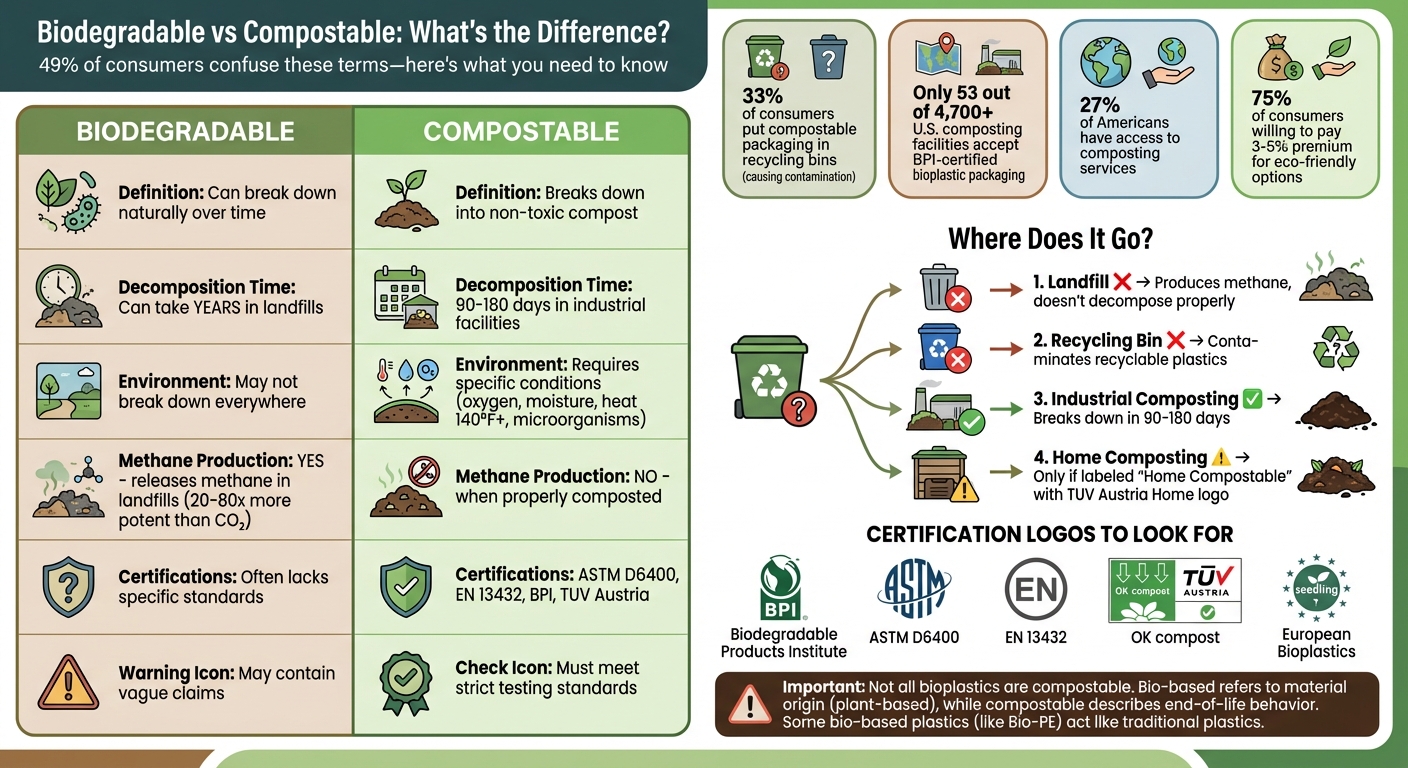
Biodegradable vs Compostable Packaging: Key Differences and Disposal Requirements
## Myth 1: Biodegradable Packaging Breaks Down Everywhere
There’s a widespread belief that biodegradable packaging will decompose no matter where it ends up. Unfortunately, that’s not how it works. Most compostable packaging requires very specific conditions to break down, and those conditions are rarely found in typical disposal environments.
### How Composting Differs from Landfill Decomposition
Industrial composting operates under carefully controlled conditions. It relies on oxygen, moisture, and specific microorganisms like bacteria and fungi to break materials down efficiently. Facilities maintain temperatures above 140°F and use tools like grinders and turners to speed up the process. Under these ideal circumstances, certified compostable packaging can decompose within 90 to 180 days.
Landfills, on the other hand, are designed for storage, not decomposition. They are compacted, oxygen-starved environments, which makes them very different from composting facilities. As one expert from Midtown Composting & Recycling explains:
> "A landfill is an anaerobic (oxygen-starved) environment. Composting is aerobic (oxygen-rich). If you toss compostable packaging in the trash, it's headed to a place where it won't break down at all."
>
> - Midtown Composting & Recycling
In landfills, compostable materials break down anaerobically (without oxygen), producing methane - a potent greenhouse gas that traps heat 20 to 80 times more effectively than carbon dioxide. This is a major issue, especially since only 53 out of the 4,700+ composting facilities in the U.S. currently accept BPI-certified compostable bioplastic packaging. Without access to these specialized facilities, the environmental benefits of compostable packaging are lost.
### Why Improper Disposal Reduces Environmental Benefits
The misconception that biodegradable packaging will break down everywhere can lead to unintended environmental harm. When compostable items are sent to landfills, they generate methane instead of enriching the soil. Tossing them in a recycling bin is also problematic - they can contaminate batches of recyclable plastics because compostable plastics look similar but require entirely different processing methods.
Another issue is the misleading nature of the "biodegradable" label. It can encourage littering, as people assume these items will naturally disappear if left outdoors. However, without the controlled heat, moisture, and microbial activity found in industrial composting facilities, most certified compostable products won’t decompose effectively in the natural environment. The Federal Trade Commission has even stated that claims of degradability are misleading if the items are disposed of in landfills, incinerators, or recycling facilities, as these environments lack the conditions needed for complete decomposition within a year.
###### sbb-itb-0c3a5ed
## Myth 2: Biodegradable Packaging Is Weak and Fragile
It’s a common misconception that biodegradable packaging is flimsy and unreliable. However, advancements in materials and engineering have made these alternatives just as durable as traditional plastics.
### How Biodegradable Materials Perform Today
Take **bagasse containers**, for example. These sturdy options can handle hot meals without losing their shape, tolerating temperatures as high as 180°F. They resist warping and leaking, unlike some conventional plastic containers, which may deform under similar conditions or even release unwanted chemicals into food.
Then, there are **biodegradable paper straws**, which have come a long way in their design. Thanks to modern moisture-resistant techniques, these straws can stay functional in beverages for over two hours - a far cry from the soggy paper straws of the past. As [Hello Straw](https://hellostraw.com/) puts it:
> "When produced properly using modern techniques, many compostable packaging materials can be quite durable and sturdy." - Hello Straw
**Polylactic acid (PLA)**, a standout in the bioplastics market, holds an impressive 31% share globally as of 2023. A study published by [Dublin City University](https://www.dcu.ie/) in November 2025 revealed that PLA could be mechanically recycled up to three times with only a 14% reduction in tensile strength. This durability is part of why bioplastics production is expected to soar from 2.18 million tonnes in 2023 to 7.43 million tonnes by 2028.
Modern manufacturing techniques ensure that biodegradable materials can protect their contents just as well as conventional plastics. These advancements help dispel the myth of fragility and provide consumers and businesses with confidence in choosing sustainable packaging alternatives.
## Myth 3: All Bioplastics Are Compostable
Not all bioplastics will decompose in a compost bin. The term "bioplastic" is broad and doesn't guarantee compostability. In reality, bio-based plastics make up only about 1% of the global plastic market, and many act just like traditional plastics.
### Bio-Based vs. Compostable: What's the Difference?
This myth creates confusion by suggesting that all bioplastics inherently break down, which can lead to misplaced trust in sustainable packaging. Here's the key difference: **bio-based** refers to the material's origin (like corn or sugarcane), while **compostable** describes what happens to it at the end of its life. For instance, Bio-PE (also called "Green PET") is made from plants but is chemically identical to petroleum-based plastics, meaning it doesn't biodegrade any faster. On the flip side, some compostable plastics, such as PBAT, are derived from fossil fuels but are designed to degrade under specific conditions.
Mariana Holguin from [Plastics Engineering](https://www.plasticsengineering.org/) sheds light on this:
> "While some bio-based plastics may not biodegrade, certain petroleum-based plastics can exhibit biodegradable properties".
The key factor here is the chemical structure, not the raw material.
Adding to the complexity, some "bioplastic" products might still contain up to 80% fossil fuel–based plastic. This is why the Sustainable Packaging Coalition advises against using the term "biodegradable" in marketing - it often misleads consumers about a product's environmental impact. Simply put, the term "bioplastic" doesn't automatically tell you how the product will behave when it's discarded.
### Spotting Certified Compostable Products
Instead of relying on vague labels, look for recognized certifications. In the U.S., the [**Biodegradable Products Institute**](https://bpiworld.org/) **(BPI)** certifies products that meet ASTM D6400 standards. These standards require that 90% of the carbon in the material converts to CO₂ within 180 days. In Europe, you can look for the **TUV Austria "OK compost" logo** or the **European Bioplastics "seedling" logo**, which indicate compliance with EN 13432 standards.
These certifications ensure that the material will break down safely. For example, certified products must disintegrate to the point where 90% of the material can pass through a 2mm sieve within 84 days in a composting environment. Without these marks, you're relying solely on the manufacturer's claims.
It's important to note that most certified compostable plastics require industrial composting facilities to properly decompose. If a product isn't explicitly labeled as "home compostable" with a **TUV Austria Home logo**, it likely won't break down in a backyard compost bin.
## Myth 4: Biodegradable Packaging Leaves Harmful Residues
Some people worry that biodegradable packaging might break down into toxic substances. This concern usually stems from uncertified products that make vague claims about being "biodegradable" without undergoing proper testing.
### How Certification and Testing Ensure Safety
Certified compostable packaging must meet strict standards, like ASTM D6400 or EN 13432, which ensure they leave no harmful residues behind. These certifications involve rigorous testing, such as:
- **Phytotoxicity testing**: Ensures the compost supports healthy plant growth and seed germination.
- **Ecotoxicity testing**: Evaluates the impact on soil organisms, often using OECD Guideline 208 protocols.
Additionally, certified products must meet limits for heavy metals and be free of harmful chemicals like PFAS. Even the inks used on the packaging are tested to ensure minimal migration potential.
Toxicologist Dr. Emily Roberts highlights the importance of real-world testing:
> "From a risk perspective, the future is not 'lab versus field' - it is 'lab plus field.' If your brand promise relies on compostability, you must verify the outcome in the environments where your packaging will actually go."
Without these certifications, there’s no guarantee that biodegradable packaging won’t pose hidden risks.
### The Risks of Uncertified Products
Uncertified "biodegradable" products can be a different story. A 2025 study conducted by NSW EPA and Flinders University examined 162 food service items and found PFAS levels as high as 86,200 μg/kg in sugarcane bagasse samples. The study also revealed that many items marketed as "compostable" or "non-plastic" - like paper straws - contained non-compostable plastic linings or adhesives.
These uncertified materials may also include harmful additives like phthalates and heavy metals, which can contaminate soil and enter the food chain. Oxo-degradable additives, often marketed as eco-friendly, break down into microplastics, contributing to ocean pollution. As the [United Nations Environment Programme](https://www.unep.org/node) warns:
> "The inclusion of a pro-oxidant, such as manganese, in oxo-degradable polymers is claimed to promote fragmentation... it should be assumed that oxo-degradable polymers will add to the quantity of microplastics in the oceans."
To avoid these risks, look for trusted certifications like the Biodegradable Products Institute (BPI) logo or the TUV Austria "OK compost" logo. These marks indicate the product has been thoroughly tested and is unlikely to leave harmful residues behind. Certification ensures that compostable packaging delivers on its promise to be safe and environmentally friendly.
## Myth 5: Biodegradable Packaging Works for Few Products
There's a common belief that compostable packaging is only suitable for simple items like napkins or paper plates. But the truth is, modern biodegradable materials are making their mark across a variety of industries, from food service to fashion.
### Compostable Packaging Options Across Industries
In the food service sector, compostable packaging now includes clamshell trays, drink carriers, egg cartons, cutlery, straws, and snack wrappers. These solutions are versatile enough to handle everything from pre-cooked meals to raw ingredients.
Outside of food, compostable materials are gaining traction in industries like fashion, home goods, cosmetics, and personal care. For instance, protective polybags made from seaweed-based materials are being adopted by the fashion industry, while agriculture is seeing the use of compostable produce stickers and fiber-based packaging.
The market is reflecting this shift in demand. Food-contact compostable packaging in the U.S. is expected to grow at an annual rate of 16% through 2032 - four times faster than traditional plastic packaging. Additionally, about 70% of composting facilities in the U.S. now accept some type of food-contact compostable packaging. On the consumer side, 75% of people are willing to pay a 3% to 5% premium for eco-friendly alternatives. These trends highlight the expanding role of compostable materials across various sectors.
### Features That Make Compostable Packaging Practical
Modern compostable packaging isn't just environmentally friendly; it's also designed with functionality in mind. The polymers used in these materials offer moisture resistance, ensuring a stable shelf life. They're engineered to handle extreme conditions, from frozen storage to microwave heating, and incorporate grease barriers to meet the demands of food service.
Different biodegradable materials bring unique benefits to the table. For instance:
- **Polylactic Acid (PLA):** Known for its transparency and strength, PLA boasts a tensile strength of around 50 MPa, far surpassing the 8 to 25 MPa range of low-density polyethylene.
- **Polyhydroxyalkanoates (PHA):** Withstanding temperatures up to 248°F (120°C), PHA is ideal for hot food applications.
- **Polybutylene Adipate Terephthalate (PBAT):** Valued for its durability and water resistance, PBAT is another standout option.
In April 2024, the [Composting Consortium](https://www.closedlooppartners.com/composting-consortium/) concluded an 18-month field study involving over 23,000 certified food-contact compostable packaging units across 10 U.S. facilities. The study tested 31 fiber and plastic products, including PLA and PHA, and found that plastic compostables achieved an average disintegration rate of 98%, while fiber products reached 83%. According to the findings:
> "The findings point to the viability of certified food-contact compostable packaging as an alternative packaging solution to single‑use conventional plastic packaging."
These materials also meet strict performance standards, such as oxygen transmission rates of ≤ 10 cm³/m²/day for freshness and water vapor transmission rates of ≤ 15 g/m²/day for moisture protection. With a projected 15% growth in the next decade, compostable packaging is poised to play a major role in sustainable product design.
## Takeaway: How to Make Better Decisions About Biodegradable Packaging
### What Businesses and Consumers Should Remember
The confusion between "compostable" and "biodegradable" is more than just a misunderstanding - it actively disrupts waste management systems. Nearly half of consumers (49%) misinterpret these terms, and 33% mistakenly place compostable packaging in recycling bins, causing contamination.
To avoid this, look for certifications like those from the Biodegradable Products Institute (BPI) or TUV Austria. These certifications confirm compliance with ASTM D6400 or EN 13432 standards, ensuring that packaging will break down into non-toxic compost within 90 to 180 days in industrial composting facilities.
However, most compostable packaging isn’t suitable for backyard composting unless specifically labeled "Home Compostable." It’s essential to check whether your local waste management system accepts compostable packaging before purchasing. Right now, only 27% of Americans have access to composting services, and many facilities are limited to processing food scraps rather than packaging materials. These limitations highlight the importance of informed choices from both consumers and businesses.
### How Businesses Can Lead the Shift to Better Packaging
Businesses have a powerful role to play in reducing confusion and improving waste management. One of the simplest yet most effective steps is ensuring clear, certified labeling. The Sustainable Packaging Coalition advises avoiding the term "biodegradable" in marketing materials. Instead, use "compostable" for certified products or "bio-based" to describe material origins. Including a certification logo alongside a clear "compostable" label can boost consumer recognition by as much as 22%.
> "The onus is on manufacturers to ensure they are communicating, certifying and labelling their packaging to support the correct end-of-life processing." – Method Recycling
Beyond labeling, businesses can advocate for systemic change by supporting the growth of composting infrastructure. They can also incorporate mandatory certifications like BPI into supplier agreements, ensuring consistency across their product lines. With 75% of consumers willing to pay a small premium (3% to 5%) for eco-friendly options, the demand for compostable packaging is clear. This creates an opportunity for businesses to make compostable packaging more accessible and mainstream.
For companies looking to combine impactful design with responsible disposal instructions, working with experts like [PKG Brand Design](https://pkgbranding.com/) can help create packaging solutions that meet both aesthetic and environmental goals.
## FAQs
### How can I tell if packaging is industrially compostable or home compostable?
To figure out if packaging is suitable for industrial or home composting, look for certifications such as **ASTM D6400**. **Industrially compostable packaging** needs the high temperatures and carefully managed conditions found in commercial composting facilities. On the other hand, **home compostable packaging** is made to decompose in the less controlled environment of a home compost setup. Always check the labels to see if the packaging is meant for home composting or if it requires industrial processing.
### What should I do if my city doesn’t accept compostable packaging?
If your city doesn’t have a composting program for compostable packaging, it’s best to throw it in the regular trash. Without commercial composting facilities, these materials often won’t decompose as intended and may just sit in landfills. While it’s not the perfect solution, it’s the most realistic choice for places lacking composting services.
### How can I avoid contaminating recycling when disposing of compostable items?
To keep things clean and sorted, make sure compostable items are **clearly labeled** and kept away from recyclable plastics. Compostable packaging is designed to break down in **commercial composting facilities**, not in regular recycling systems. Tossing them into standard recycling bins can cause issues. Always look for proper labels and place compostable materials in the correct composting bins to prevent mixing them with recyclables.
## Related Blog Posts
- [How Strategic Packaging Design Increases Sales](https://www.pkgbranding.com/blog/strategic-packaging-design-increases-sales)
- [Discover the Ingredients for Creating a Great Brand Identity](https://www.pkgbranding.com/blog/brand-identity-creation-ingredients)
- [5 Common Packaging Design Mistakes and How to Fix Them](https://www.pkgbranding.com/blog/common-packaging-design-mistakes-how-to-fix)
- [Luxury Packaging Design: Balancing Elegance and Sustainability](https://www.pkgbranding.com/blog/luxury-packaging-design-elegance-sustainability)
- [Facebook Share ](https://www.facebook.com/sharer/sharer.php?u=https%3A%2F%2Fwww.pkgbranding.com%2Fblog%2Fbiodegradable-packaging-myths-consumers-believe)
- [Twitter Share ](https://twitter.com/home?status=Top+Biodegradable+Packaging+Myths+Consumers+Believe%20https%3A%2F%2Fwww.pkgbranding.com%2Fblog%2Fbiodegradable-packaging-myths-consumers-believe)
- [LinkedIn Share ](https://www.linkedin.com/shareArticle?mini=true&url=https%3A%2F%2Fwww.pkgbranding.com%2Fblog%2Fbiodegradable-packaging-myths-consumers-believe&title=Top%20Biodegradable%20Packaging%20Myths%20Consumers%20Believe&summary=Clears+up+five+common+myths+about+biodegradable+and+compostable+packaging%2C+explains+certifications%2C+disposal+rules%2C+and+real+environmental+trade-offs.&source=)
- [Email Share ](mailto:?subject=Top%20Biodegradable%20Packaging%20Myths%20Consumers%20Believe&body=https%3A%2F%2Fwww.pkgbranding.com%2Fblog%2Fbiodegradable-packaging-myths-consumers-believe)
### Topics
- [Blog](https://www.pkgbranding.com/blog/topic/blog)
### Related Posts
[ How Multisensory Packaging Impacts Brand Loyalty Kevin Keating at PKG ](https://www.pkgbranding.com/blog/multisensory-packaging-impacts-brand-loyalty) [ 7 Emotional Triggers That Drive Packaging Success Kevin Keating at PKG ](https://www.pkgbranding.com/blog/emotional-triggers-packaging-success) [ How Social Media Listening Improves Packaging Design Kevin Keating at PKG ](https://www.pkgbranding.com/blog/social-media-listening-improves-packaging-design)
### Subscribe Now!
### Subscribe Now!
**Awarded Top 50**
**Package Design ****Blog**
[](http://blog.feedspot.com/packaging_design_blogs/)
- [How Multisensory Packaging Impacts Brand Loyalty](https://www.pkgbranding.com/blog/multisensory-packaging-impacts-brand-loyalty)
- [7 Emotional Triggers That Drive Packaging Success](https://www.pkgbranding.com/blog/emotional-triggers-packaging-success)
- [How Social Media Listening Improves Packaging Design](https://www.pkgbranding.com/blog/social-media-listening-improves-packaging-design)
- [11 Examples of Functional Packaging Features](https://www.pkgbranding.com/blog/functional-packaging-features-examples)
- [Competitor Analysis for Shelf Differentiation](https://www.pkgbranding.com/blog/competitor-analysis-for-shelf-differentiation)
- [Typography Checklist for Packaging](https://www.pkgbranding.com/blog/typography-checklist-packaging)
- [Top Biodegradable Packaging Myths Consumers Believe](https://www.pkgbranding.com/blog/biodegradable-packaging-myths-consumers-believe)
- [Macro Photography for Food Packaging Design](https://www.pkgbranding.com/blog/macro-photography-food-packaging-design)
- [Glass Packaging Benefits for CPG Brands](https://www.pkgbranding.com/blog/glass-packaging-benefits-cpg-brands)
- [Pet Food Packaging: FDA Rules to Know](https://www.pkgbranding.com/blog/pet-food-packaging-fda-rules)

Recognized as a
Top Package Design Agency
on [DesignRush](https://www.designrush.com/agency/package-design)
PKG BRAND DESIGN
2045 W Grand Ave, STE B-27332
Chicago, IL 60612-1576
[312.870.9101](tel:+1.312.870.9101)
 [Request a Free Consultation](https://www.pkgbranding.com/request-a-consultation)
[](https://www.hangar-12.com/)
© 2026 PKG Brand Design. All Rights Reserved

```json
{
"@context" : "http://schema.org",
"@type" : "BlogPosting",
"author" : {
"@type" : "Person",
"name" : "Kevin Keating at PKG"
},
"dateModified" : "April 1, 2026, 3:55:04 AM",
"datePublished" : "2026-02-23 21:18:38",
"description" : "Clears up five common myths about biodegradable and compostable packaging, explains certifications, disposal rules, and real environmental trade-offs.",
"headline" : "Top Biodegradable Packaging Myths Consumers Believe",
"image" : {
"@type" : "ImageObject",
"url" : "https://assets.seobotai.com/cdn-cgi/image/quality=75,w=1536,h=1024/pkgbranding.com/699cbb71efc60cc2af09571a-1771881614185.jpg"
},
"publisher" : {
"@type" : "Organization",
"logo" : {
"@type" : "ImageObject",
"url" : "https://cdn2.hubspot.net/hubfs/537000/PKG-1.png"
},
"name" : "PKG Brand Design"
}
}
```
```json
{
"@context" : "https://schema.org",
"@type" : "FAQPage",
"mainEntity" : [ {
"@type" : "Question",
"acceptedAnswer" : {
"@type" : "Answer",
"text" : "To figure out if packaging is suitable for industrial or home composting, look for certifications such as ASTM D6400. Industrially compostable packaging needs the high temperatures and carefully managed conditions found in commercial composting facilities. On the other hand, home compostable packaging is made to decompose in the less controlled environment of a home compost setup. Always check the labels to see if the packaging is meant for home composting or if it requires industrial processing.
"
},
"name" : "How can I tell if packaging is industrially compostable or home compostable?"
}, {
"@type" : "Question",
"acceptedAnswer" : {
"@type" : "Answer",
"text" : "If your city doesn’t have a composting program for compostable packaging, it’s best to throw it in the regular trash. Without commercial composting facilities, these materials often won’t decompose as intended and may just sit in landfills. While it’s not the perfect solution, it’s the most realistic choice for places lacking composting services.
"
},
"name" : "What should I do if my city doesn’t accept compostable packaging?"
}, {
"@type" : "Question",
"acceptedAnswer" : {
"@type" : "Answer",
"text" : "To keep things clean and sorted, make sure compostable items are clearly labeled and kept away from recyclable plastics. Compostable packaging is designed to break down in commercial composting facilities, not in regular recycling systems. Tossing them into standard recycling bins can cause issues. Always look for proper labels and place compostable materials in the correct composting bins to prevent mixing them with recyclables.
"
},
"name" : "How can I avoid contaminating recycling when disposing of compostable items?"
} ]
}
```