---
title: Social Media Listening for Packaging
description: Social listening uncovers real packaging problems, visual trends, and accessibility demands so brands can redesign, test, and measure impact.
image: https://assets.seobotai.com/cdn-cgi/image/quality=75,w=1536,h=1024/pkgbranding.com/699d5fe4efc60cc2af098e8a-1771924055807.jpg
---
[ ](https://www.pkgbranding.com/)
[ ](https://www.hangar-12.com/)
[312.870.9101](tel:+1.312.870.9101)
# Consumer First Insights
## How Social Media Listening Improves Packaging Design
Written by Kevin Keating at PKG
Social media listening helps brands improve packaging by analyzing online conversations for actionable insights. Instead of relying on traditional focus groups, companies use tools like [Brandwatch](https://www.brandwatch.com/) or [Hootsuite](https://www.hootsuite.com/) to monitor consumer feedback on platforms like Instagram, TikTok, and Reddit. This method identifies issues like hard-to-open lids or excessive plastic use and uncovers trends in design preferences. For example:
- [**StarKist**](https://starkist.com/) redesigned packaging after learning Gen Z preferred pouches over cans, boosting sales by 75%.
- **Grillo’s Pickles** switched to twist-off lids after complaints about spills and accessibility, earning positive feedback.
- [**Tilt Beauty**](https://tiltbeauty.com/) created arthritis-friendly packaging with magnetic closures, winning awards for ease of use.
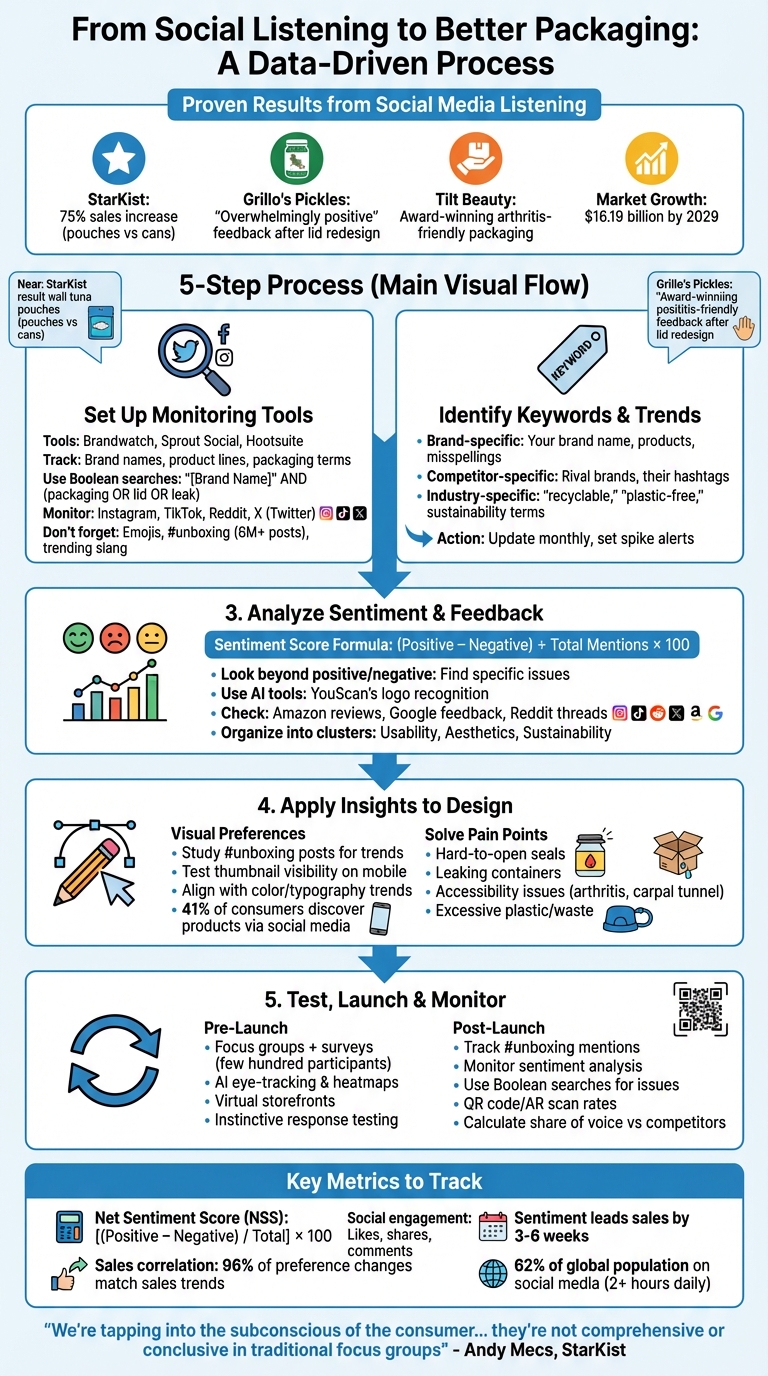
5-Step Social Media Listening Process for Packaging Design Optimization
## Using Social Media Listening Tools to Gather Packaging Data
Start by defining your goals. Are you looking to identify packaging issues, evaluate new design launches, or compare your brand to competitors? Your objectives will guide which platforms to monitor and what keywords to track. From there, refine your search terms to align with evolving consumer language and trends.
Tools like Brandwatch, [Sprout Social](https://sproutsocial.com/), and Hootsuite can help you set up alerts for your brand name, product lines, and packaging-related terms. Use Boolean searches, such as `"[Brand Name]" AND (packaging OR lid OR leak)`, to filter relevant discussions. Don’t overlook emojis, popular hashtags like **#unboxing**, or trending slang - these can provide valuable insights into consumer sentiment.
Sentiment analysis plays a key role in turning data into actionable insights. These tools categorize mentions as positive, neutral, or negative and calculate a sentiment score: *(Positive – Negative) ÷ Total Mentions × 100*. A great example comes from Grillo's Pickles, which used social media listening to uncover years of complaints about their "lift-up" lids. Consumers reported spills and broken nails, prompting the company to redesign the lids to a twist-off version in early 2024. The result? "Overwhelmingly positive" feedback, especially from customers with accessibility needs like carpal tunnel.
### Finding Keywords and Trends to Track
To track the right keywords, organize your searches into three main categories:
- **Brand-specific terms:** Include your brand name, product names, and common misspellings.
- **Competitor-specific terms:** Monitor rival brands and their popular hashtags.
- **Industry-specific terms:** Focus on packaging trends and terms like "recyclable", "plastic-free", or other sustainability-related language.
Platforms like Instagram and TikTok are great for spotting visual trends, while Reddit and X (formerly Twitter) often provide raw, unfiltered feedback. For instance, Fix My Curls discovered through social listening that consumers found their original packaging "unattractive." They used this feedback to guide a complete redesign.
Don’t let your keyword library stagnate. Update it monthly to include new slang, trending hashtags, or emerging concerns. Spike alerts can also be invaluable, notifying your team of sudden increases in mentions - whether it’s a packaging crisis or a viral design trend. Notably, the social listening market is projected to grow to $16.19 billion by 2029.
### Analyzing Consumer Feedback and Sentiment
Once you’ve gathered data, the next step is analysis. Go beyond basic positive or negative sentiment to pinpoint specific issues. Are people frustrated with "hard-to-open" seals, complaining about "wasted space", or praising a competitor's eco-friendly design? These details can directly inform your packaging decisions.
Visual analysis tools, like [YouScan](https://youscan.io/)’s AI-driven logo recognition, are particularly useful for capturing packaging images - even when there’s no text. This allows you to gather authentic, unsolicited feedback. Wendy Scherer, Managing Partner at Social Studies Group, explains:
> "If they just put it out there on social media, it's unsolicited... I feel like it's more true".
Review platforms like Amazon and Google also provide structured feedback on packaging quality, durability during shipping, and sustainability concerns. Meanwhile, niche forums and Reddit threads often dive into technical details, including materials and compliance issues. Some tools even organize feedback into clusters, such as "usability", "aesthetics", or "sustainability", making it easier to spot trends.
###### sbb-itb-0c3a5ed
## Applying Social Media Insights to Packaging Design
Social media insights can be a goldmine for improving packaging, both in terms of looks and functionality. By analyzing trends and consumer feedback, brands can make packaging more appealing and practical.
### Using Visual Preferences and Trends
Consumer feedback on platforms like Instagram and TikTok offers a direct line to what people find visually appealing. For example, the **#unboxing** hashtag has over 6 million posts on Instagram, showcasing what packaging stands out, photographs well, and gets shared. This is invaluable for brands looking to create designs that resonate.
Pay attention to visual elements like color, typography, and design style. Take [Starbucks](https://www.starbucks.com/), for instance. In 2017, the company tapped into the viral unicorn and rainbow trends on Snapchat to launch its Unicorn Frappuccino. The vibrant, Instagram-friendly packaging encouraged users to share photos, leading to an explosion of user-generated content.
Another key consideration is how packaging looks as a thumbnail. On mobile screens, clean layouts and bold fonts are easier to read and more eye-catching. Testing designs at smaller sizes ensures they stand out in crowded social feeds [9, 21].
Emerging design trends are also worth exploring. From bright, joyful colors to sleek, minimalist styles, aligning your packaging with these aesthetics can help your brand stay relevant. This is especially important when 41% of consumers discover new products through social media.
While eye-catching designs attract attention, functionality ensures long-term customer satisfaction.
### Solving Consumer Pain Points
Practicality matters just as much as appearance. Social media often highlights common frustrations like leaking containers, hard-to-open seals, or excessive waste. Addressing these issues can turn complaints into praise and build customer loyalty.
Grillo's Pickles is a perfect example. After years of complaints about its lift-up lids causing spills and even broken nails, the company worked with [Berry Global](https://en.wikipedia.org/wiki/Berry_Global) in 2024 to redesign its jars with a twist-off closure. Eddie Andre, VP of Branding, explained:
> "We knew the jar was our biggest consumer pain point... Now you can twist off the lid with no spills or sore fingers".
The redesign was a hit, with social media users praising the improved accessibility.
To tackle functionality issues, brands can use Boolean searches to track recurring complaints by pairing their name with terms like "hard to open", "leaking", or "non-recyclable." Once the problems are clear, work with suppliers to create prototypes that address these concerns. Sharing these updates on social media shows customers that their feedback matters.
Accessibility is another area gaining attention. Social media users frequently call for packaging that’s easier to open, especially for those with conditions like arthritis or carpal tunnel. Tilt Beauty addressed this in October 2025 with a packaging system featuring magnetic closures, slip-resistant materials, and an easy-to-read typeface. Their design earned the Arthritis Foundation's "Ease of Use" certification and multiple awards.
Sustainability is a hot topic as well. Consumers often criticize excessive plastic or wasted space in packaging [3, 19]. In response, Glossier adopted a simpler, more eco-conscious design, reducing material use without sacrificing its signature look. Tracking keywords like "recyclable", "plastic-free", or "eco-friendly" can help brands meet these evolving expectations while staying aligned with consumer values.
## Testing and Refining Packaging Designs
After gathering insights from social media and creating prototypes, the next step is crucial: testing. This ensures your design resonates with consumers and avoids the risk of launching something that misses the mark.
### Running Consumer Research and Testing
Before unveiling new packaging, it's essential to validate your concepts with real consumers. A mix of **qualitative methods** (like focus groups or interviews) and **quantitative approaches** (such as surveys or A/B tests) helps confirm whether the trends you’ve identified actually influence purchasing decisions.
Start with clear questions like, *“Does this color communicate sustainability?”* or *“Is the design eye-catching enough?”* Aim for a sample size of a few hundred participants per test to ensure your data is dependable.
Advanced tools like **AI-powered eye-tracking** can reveal where consumers focus their attention on your packaging. Heatmaps generated from these tools highlight which elements stand out and how long they hold attention. Another option is using **virtual storefronts**, which simulate how your product looks on a digital shelf alongside competitors. This can help predict how it might perform in a retail setting.
Kevin Keating, President of PKG Brand Design, stresses the importance of testing in real-world conditions: "While data can easily be misinterpreted, nothing matches the strategic value of directly observing consumers during purchase and product usage."
To ensure your design stands out, test it against your competitors’ packaging. One effective method is **instinctive response testing**, where participants view your design for just a few seconds and then share what they recall. This approach can assess whether your packaging is memorable enough to leave a lasting impression.
Once your design passes these tests, the focus shifts to gathering feedback after the product hits the shelves.
### Monitoring Social Media Feedback After Launch
After launch, it’s essential to keep tracking how consumers respond to your packaging through tools like Brandwatch or Hootsuite.
Use **sentiment analysis** to categorize mentions as positive, neutral, or negative. Engagement metrics - such as likes, shares, and comments on launch-related posts - can provide a clear picture of how well your design resonates.
Pay close attention to hashtags like **#unboxing** and direct messages, as these often highlight practical issues that might not have surfaced during pre-launch testing. Boolean searches can help you filter feedback efficiently. For instance, pairing your brand name with terms like *“hard to open”* or *“leaking”* can quickly pinpoint specific problems.
One example of a successful redesign showed immediate positive sentiment and high engagement, validating the effort behind the new look.
To stay on top of consumer feedback, use live dashboards to share real-time sentiment data with your team. Encourage feedback by offering polls or discounts. Finally, keep an eye on monthly growth in mentions - especially in niche product categories - as it can indicate rising success.
## Measuring the Results of Packaging Changes
Evaluating the success of your updated packaging involves analyzing both sales data and social media activity. This process links consumer reactions directly to your design choices, offering a clear view of how your packaging resonates in the market.
### Tracking Engagement and Sales Data
Start by monitoring social media engagement - likes, shares, comments, and retweets - on posts using popular hashtags like #unboxing. With over 6 million posts tagged on Instagram alone, this hashtag provides a treasure trove of consumer reactions and first impressions.
Incorporating connected packaging elements, such as QR codes or augmented reality, can transform your product into a digital touchpoint. These features allow you to track scan rates and follow-up actions, giving you real-time insights into customer behavior. As Mark Hewitt from [ProFood World](https://www.profoodworld.com/) puts it:
"Your pack becomes an owned channel... It's commercial dynamite".
Feedback from influencers also plays a pivotal role. When key opinion leaders (KOLs) share their thoughts on your packaging, their opinions often carry more influence than general consumer feedback.
Additionally, calculate your brand’s share of voice by measuring how often your brand is mentioned compared to competitors. Pair this with year-over-year sales data following your redesign. Research from [Designalytics](https://www.designalytics.com/) shows that 96% of the time, changes in purchase preferences correlate with sales trends. These metrics demonstrate the power of social media insights in shaping packaging decisions, aligning with the Consumer First® approach to refine designs based on real-world feedback.
### Monitoring Consumer Sentiment Over Time
Beyond immediate engagement, tracking consumer sentiment over time helps determine whether your packaging maintains its appeal. Use a Net Sentiment Score (NSS) to measure this, calculated as:
[(Positive Mentions – Negative Mentions) / Total Mentions] × 100.
This score can act as an early indicator of sales performance, which typically lags behind sentiment by three to six weeks.
Keep an eye on sentiment volatility to assess the stability of consumer perception. Low volatility suggests consistent positive feedback, while high volatility may indicate fluctuating or polarizing opinions. Set up alerts for sudden spikes in negative mentions, such as "Brand + Leak" or "Brand + Broken", to address potential issues quickly. However, remember that automated sentiment analysis tools can misinterpret up to 30% of data due to sarcasm or irony, so human review remains essential for critical reports.
It’s also important to recognize that social media feedback often skews younger, potentially missing input from older consumers who are less active online. Neil Cowan, Brand Design Director at Kellogg's, highlights the importance of a balanced approach:
"Having an objective, data-driven evaluation on how our current design performs at any given time is critical. This alerts us to potential issues and opportunities and helps remove subjectivity".
To get a well-rounded view, combine social media insights with traditional surveys. While over 62% of the global population uses social media, integrating this data with other research methods ensures you capture perspectives from all consumer segments.
## Conclusion
Social media listening has shifted packaging design from guesswork to a process rooted in real consumer insights. By diving into real-time conversations, brands can pinpoint functional issues, tap into subconscious needs, and respond to visual trends more quickly than traditional research methods ever could. Just look at the results: StarKist boosted its pouch category by **75%**, and Grillo's Pickles turned years of complaints into "overwhelmingly positive" feedback.
This highlights the importance of going beyond standard focus groups. Instead of relying solely on what consumers *say*, brands can uncover how they actually behave and feel through their social media activity. As Andy Mecs from StarKist puts it:
"We're tapping into the subconscious of the consumer. In a traditional focus group, we would have some takeaways, but they're not comprehensive or conclusive".
Such unfiltered feedback provides a clearer picture of how packaging performs in the real world.
A consumer-first approach weaves these insights directly into the design process. [PKG Brand Design](https://pkgbranding.com/)’s Consumer First® methodology is a great example - it uses real consumer behavior and sentiment to shape every design decision, whether it’s choosing colors that pop on mobile screens or rethinking structures to address functional challenges.
With over **62% of the global population** spending more than two hours daily on social media, brands have unprecedented access to honest, unvarnished feedback. The brands that stand out are those that treat packaging as an ongoing dialogue with their consumers, not just a one-off creative endeavor. By listening, testing, and refining continuously, they create designs that truly resonate.
## FAQs
### What should I track in social listening for packaging?
To get a better grasp of what consumers think, start by keeping tabs on **brand mentions, hashtags, and online reviews**. These can reveal a lot about customer preferences and overall sentiment. Dive into **user-generated content (UGC)** to observe how people interact with your packaging - this can offer real-world insights into what works and what doesn’t.
It’s also smart to monitor **trending topics, competitor mentions, and engagement metrics**. These can help you spot new trends and shifts in the market. By analyzing these insights, you can fine-tune your packaging design to better match what consumers want and expect.
### How do I turn social feedback into design changes?
To kick things off, gather feedback directly from your audience. Tap into tools like social media listening, conduct surveys, or dig into customer reviews. These channels can reveal patterns in preferences, recurring concerns, or standout likes and dislikes.
Once you've got the data, focus on the insights that can drive real improvements. Work closely with your design team to tweak aspects like the packaging's look, messaging, or even its structure. The key is to make sure these updates reflect what your customers are asking for.
After implementing changes, keep an eye on how they’re received. Use social media and other feedback channels to see if the adjustments resonate, and don’t hesitate to fine-tune further based on what you learn.
### How can I prove a packaging redesign worked?
To gauge whether your packaging redesign hit the mark, focus on gathering insights from **social media listening** and **consumer feedback**. Here’s how:
- **Monitor social media activity**: Look for changes in brand mentions, engagement rates, and the amount of user-generated content. An uptick in these areas often signals positive reception.
- **Leverage consumer surveys**: Directly ask your audience for their thoughts on the new design. Surveys can provide valuable, targeted insights.
- **Analyze organic feedback**: Pay attention to spontaneous comments on social platforms. People often share their opinions unprompted, offering raw, unfiltered reactions.
Another key step? Compare **pre- and post-redesign data**. Look at sales trends and overall sentiment before and after the change. This combination of metrics provides a solid foundation to evaluate how well your redesign connects with your audience.
## Related Blog Posts
- [How Strategic Packaging Design Increases Sales](https://www.pkgbranding.com/blog/strategic-packaging-design-increases-sales)
- [7 Ways Consumer Insights Improve Product Packaging](https://www.pkgbranding.com/blog/consumer-insights-improve-product-packaging)
- [What Makes Packaging Design Effective: Q&A](https://www.pkgbranding.com/blog/what-makes-packaging-design-effective)
- [Competitor Analysis for Shelf Differentiation](https://www.pkgbranding.com/blog/competitor-analysis-for-shelf-differentiation)
- [Facebook Share ](https://www.facebook.com/sharer/sharer.php?u=https%3A%2F%2Fwww.pkgbranding.com%2Fblog%2Fsocial-media-listening-improves-packaging-design)
- [Twitter Share ](https://twitter.com/home?status=How+Social+Media+Listening+Improves+Packaging+Design%20https%3A%2F%2Fwww.pkgbranding.com%2Fblog%2Fsocial-media-listening-improves-packaging-design)
- [LinkedIn Share ](https://www.linkedin.com/shareArticle?mini=true&url=https%3A%2F%2Fwww.pkgbranding.com%2Fblog%2Fsocial-media-listening-improves-packaging-design&title=How%20Social%20Media%20Listening%20Improves%20Packaging%20Design&summary=Social+listening+uncovers+real+packaging+problems%2C+visual+trends%2C+and+accessibility+demands+so+brands+can+redesign%2C+test%2C+and+measure+impact.&source=)
- [Email Share ](mailto:?subject=How%20Social%20Media%20Listening%20Improves%20Packaging%20Design&body=https%3A%2F%2Fwww.pkgbranding.com%2Fblog%2Fsocial-media-listening-improves-packaging-design)
### Topics
- [Blog](https://www.pkgbranding.com/blog/topic/blog)
### Related Posts
[ How Multisensory Packaging Impacts Brand Loyalty Kevin Keating at PKG ](https://www.pkgbranding.com/blog/multisensory-packaging-impacts-brand-loyalty) [ 7 Emotional Triggers That Drive Packaging Success Kevin Keating at PKG ](https://www.pkgbranding.com/blog/emotional-triggers-packaging-success)
### Subscribe Now!
### Subscribe Now!
**Awarded Top 50**
**Package Design ****Blog**
[](http://blog.feedspot.com/packaging_design_blogs/)
- [How Multisensory Packaging Impacts Brand Loyalty](https://www.pkgbranding.com/blog/multisensory-packaging-impacts-brand-loyalty)
- [7 Emotional Triggers That Drive Packaging Success](https://www.pkgbranding.com/blog/emotional-triggers-packaging-success)
- [How Social Media Listening Improves Packaging Design](https://www.pkgbranding.com/blog/social-media-listening-improves-packaging-design)
- [11 Examples of Functional Packaging Features](https://www.pkgbranding.com/blog/functional-packaging-features-examples)
- [Competitor Analysis for Shelf Differentiation](https://www.pkgbranding.com/blog/competitor-analysis-for-shelf-differentiation)
- [Typography Checklist for Packaging](https://www.pkgbranding.com/blog/typography-checklist-packaging)
- [Top Biodegradable Packaging Myths Consumers Believe](https://www.pkgbranding.com/blog/biodegradable-packaging-myths-consumers-believe)
- [Macro Photography for Food Packaging Design](https://www.pkgbranding.com/blog/macro-photography-food-packaging-design)
- [Glass Packaging Benefits for CPG Brands](https://www.pkgbranding.com/blog/glass-packaging-benefits-cpg-brands)
- [Pet Food Packaging: FDA Rules to Know](https://www.pkgbranding.com/blog/pet-food-packaging-fda-rules)

Recognized as a
Top Package Design Agency
on [DesignRush](https://www.designrush.com/agency/package-design)
PKG BRAND DESIGN
2045 W Grand Ave, STE B-27332
Chicago, IL 60612-1576
[312.870.9101](tel:+1.312.870.9101)
 [Request a Free Consultation](https://www.pkgbranding.com/request-a-consultation)
[](https://www.hangar-12.com/)
© 2026 PKG Brand Design. All Rights Reserved

```json
{
"@context" : "http://schema.org",
"@type" : "BlogPosting",
"author" : {
"@type" : "Person",
"name" : "Kevin Keating at PKG"
},
"dateModified" : "May 27, 2026, 7:16:37 PM",
"datePublished" : "2026-02-24 09:04:22",
"description" : "Social listening uncovers real packaging problems, visual trends, and accessibility demands so brands can redesign, test, and measure impact.",
"headline" : "How Social Media Listening Improves Packaging Design",
"image" : {
"@type" : "ImageObject",
"url" : "https://assets.seobotai.com/cdn-cgi/image/quality=75,w=1536,h=1024/pkgbranding.com/699d5fe4efc60cc2af098e8a-1771924055807.jpg"
},
"publisher" : {
"@type" : "Organization",
"logo" : {
"@type" : "ImageObject",
"url" : "https://cdn2.hubspot.net/hubfs/537000/PKG-1.png"
},
"name" : "PKG Brand Design"
}
}
```
```json
{
"@context" : "https://schema.org",
"@type" : "FAQPage",
"mainEntity" : [ {
"@type" : "Question",
"acceptedAnswer" : {
"@type" : "Answer",
"text" : "To get a better grasp of what consumers think, start by keeping tabs on brand mentions, hashtags, and online reviews. These can reveal a lot about customer preferences and overall sentiment. Dive into user-generated content (UGC) to observe how people interact with your packaging - this can offer real-world insights into what works and what doesn’t.
It’s also smart to monitor trending topics, competitor mentions, and engagement metrics. These can help you spot new trends and shifts in the market. By analyzing these insights, you can fine-tune your packaging design to better match what consumers want and expect.
"
},
"name" : "What should I track in social listening for packaging?"
}, {
"@type" : "Question",
"acceptedAnswer" : {
"@type" : "Answer",
"text" : "To kick things off, gather feedback directly from your audience. Tap into tools like social media listening, conduct surveys, or dig into customer reviews. These channels can reveal patterns in preferences, recurring concerns, or standout likes and dislikes.
Once you've got the data, focus on the insights that can drive real improvements. Work closely with your design team to tweak aspects like the packaging's look, messaging, or even its structure. The key is to make sure these updates reflect what your customers are asking for.
After implementing changes, keep an eye on how they’re received. Use social media and other feedback channels to see if the adjustments resonate, and don’t hesitate to fine-tune further based on what you learn.
"
},
"name" : "How do I turn social feedback into design changes?"
}, {
"@type" : "Question",
"acceptedAnswer" : {
"@type" : "Answer",
"text" : "To gauge whether your packaging redesign hit the mark, focus on gathering insights from social media listening and consumer feedback. Here’s how:
- Monitor social media activity: Look for changes in brand mentions, engagement rates, and the amount of user-generated content. An uptick in these areas often signals positive reception.
- Leverage consumer surveys: Directly ask your audience for their thoughts on the new design. Surveys can provide valuable, targeted insights.
- Analyze organic feedback: Pay attention to spontaneous comments on social platforms. People often share their opinions unprompted, offering raw, unfiltered reactions.
Another key step? Compare pre- and post-redesign data. Look at sales trends and overall sentiment before and after the change. This combination of metrics provides a solid foundation to evaluate how well your redesign connects with your audience.
"
},
"name" : "How can I prove a packaging redesign worked?"
} ]
}
```