
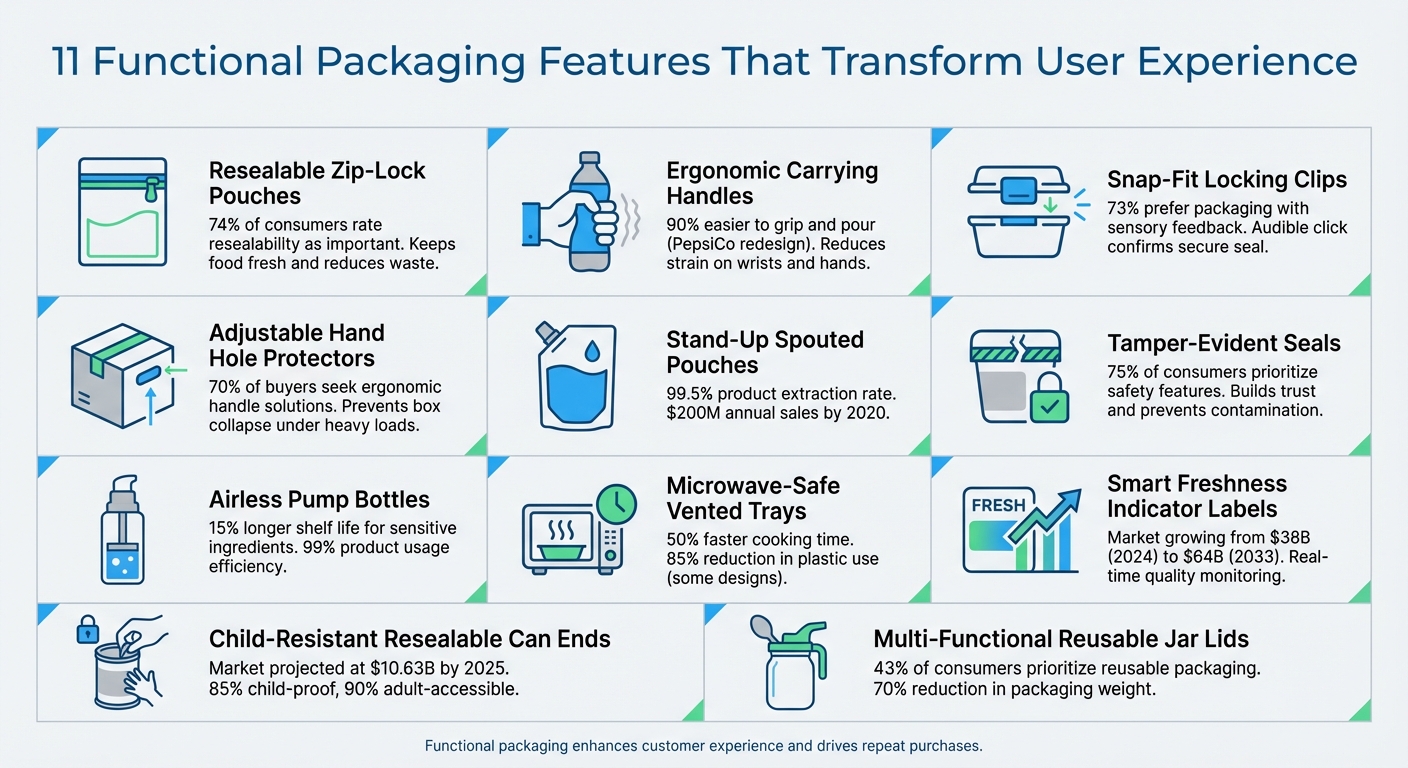
Packaging isn't just about holding products - it's about making life easier. From resealable pouches to ergonomic handles, brands are rethinking design to meet everyday needs. Here's a quick look at the key features:
- Resealable Zip-Lock Pouches: Keep food fresh and reduce waste with secure, reusable closures.
- Ergonomic Carrying Handles: Easier to grip and carry heavy items without strain.
- Snap-Fit Locking Clips: Provide a secure seal with audible feedback for freshness.
- Adjustable Hand Hole Protectors: Reinforce box grips for safer, more comfortable lifting.
- Stand-Up Spouted Pouches: Flexible, space-saving packaging for liquids.
- Tamper-Evident Seals: Build trust with visible safety features.
- Airless Pump Bottles: Protect sensitive ingredients and minimize waste.
- Microwave-Safe Vented Trays: Simplify heating with built-in steam-release mechanisms.
- Smart Freshness Indicator Labels: Real-time updates on product quality to reduce waste.
- Child-Resistant Resealable Can Ends: Keep harmful products secure from children.
- Multi-Functional Reusable Jar Lids: Extend packaging life with reusable designs.
These features aren't just practical - they're shaping how consumers interact with products, making packaging a crucial part of the overall experience.
11 Functional Packaging Features That Enhance User Experience
1. Resealable Zip-Lock Pouches
Resealable zip-lock pouches have become a go-to solution across industries, thanks to their ability to maintain freshness and prevent messy spills. The zipper creates a tight seal that slows air and moisture exchange, preserving the taste, aroma, and nutritional value of food products. For items like coffee, protein powders, or supplements, the secure closure also keeps everything neatly contained, avoiding spills. This straightforward design has paved the way for even more advanced packaging innovations.
It’s no surprise that 74% of consumers rate resealability as a "somewhat or very important" feature when deciding what to buy. This preference aligns with changing household dynamics - 61% of Americans now live in one- or two-person households, increasing the demand for packaging that can be opened and resealed multiple times. These pouches also eliminate the hassle of using clips, twist-ties, or transferring products to separate containers, keeping items in their original branded packaging.
"Slider technology offers easy access to package contents for consumers and prolongs brand exposure by eliminating the need to transfer a product into another container." - Elizabeth Sheaffer, Marketing Manager, Zip-Pak
Recent innovations have taken these pouches to the next level. Features like audible clicks that confirm a secure seal build consumer confidence. For instance, in 2025, Kellogg's introduced the "Pour & Lok" resealable side-gusset zipper for its Coco Pops cereal packaging. This design turned the pouch into a convenient pour spout that could be securely resealed, helping the brand stand out during a tough period in the cereal market.
These pouches aren't just about keeping food fresh - they address a wide range of needs across different sectors. From food and health products to household items, they’ve proven their versatility. For example, child-resistant sliders for laundry detergent pods help prevent accidental ingestion, offering a practical safety feature. With nearly $165 billion in U.S. food waste tied to freshness loss, resealable pouches are a win-win for both consumers and brands.
sbb-itb-0c3a5ed
2. Ergonomic Carrying Handles
A well-thought-out handle can make transporting heavy or bulky items - like soda packs or detergent gallons - a lot easier. Ergonomic handles are designed to reduce strain by avoiding awkward wrist angles and distributing weight more evenly across your hand. For larger or heavier items, packaging often incorporates "power grip zones" or molded grips that cater to different hand sizes and pouring methods. These improvements are becoming increasingly common in packaging for beverages, spirits, and other products.
Take PepsiCo's redesign of its 2-liter bottle for Pepsi and MTN DEW in 2019, for example. After testing hundreds of 3D prototypes, the company created a bottle that was 90% easier to grip and pour, according to PepsiCo Gutcheck In-Home User Testing. They also managed to cut the plastic used in the label by 24%. The original bottle had a 13.4-inch circumference, which was far larger than the average human hand's grasping range of 7 to 8.6 inches.
"How you hold it, pour it, how to make the experience better from a usability and ergonomic standpoint... That's the key anchor: We wanted to make the product more useful." - Mauro Porcini, SVP and Chief Design Officer, PepsiCo
Other brands are also embracing ergonomic designs to improve usability and sustainability. In 2023, Coca-Cola HBC Austria teamed up with DS Smith and Krones to introduce the "DS Smith Lift Up", a 100% recyclable corrugated handle for 1.5-liter PET multi-packs. This handle features a soft grip for better comfort and is expected to eliminate 200 tonnes of plastic annually. Another example is West Shefford Brewing Company, which in November 2015 introduced retractable handles for its craft beer six-packs. These handles make carrying easier while allowing the packs to stack efficiently when the handle slides down into the carton.
In the spirits industry, The 86 Co. collaborated with physical therapists in 2015 to design a bartender-friendly glass bottle. This bottle includes three distinct grip zones: a long neck with a rim for pulling from bar wells, a molded waistband for smaller hands, and a flared base for secure handling from upper shelves. This thoughtful design not only enhances usability but also helps prevent repetitive motion injuries, showing how ergonomic packaging can directly address real-world challenges.
These examples demonstrate how integrating consumer feedback into packaging design can lead to products that are both practical and user-friendly. This philosophy is central to the Consumer First® approach, which prioritizes usability in every aspect of packaging design - a principle championed by PKG Brand Design.
3. Snap-Fit Locking Clips
Snap-fit locking clips rely on the flexibility of plastic to form a secure mechanical lock. The design involves a hook or bead that flexes as the package is closed, then snaps into a groove to seal it. This mechanism provides both an audible click and tactile feedback, reassuring consumers that their products - whether food or household items - are properly sealed to protect against moisture, bacteria, and mold growth. Fresh-Lock's advancements in this area highlight how this principle is being put to use.
In 2022, Fresh-Lock launched the "Click 'N Lock" sensory zipper for cheese packaging. This double-lock system offers a clear click sound and a tactile feel, ensuring a tight seal that preserves moisture and prevents mold. During consumer testing, 73% of participants expressed a preference for reclosable packaging that provided sensory feedback, reinforcing confidence that the package was securely closed.
Snap-fit clips aren't limited to food storage. In 2017, Aptar Food + Beverage showcased the Daisy Brand Squeeze-Flexible sour cream pouch, which combines mess-free dispensing with resealability. Dave Johnson, Strategic Business Development Manager at Aptar, explained:
"Fitments provide added security with intuitive tamper-evident designs that you can see, hear and feel if the package has been tampered with".
These clips also contribute to sustainability. By being integrated directly into the packaging, they eliminate the need for additional components like screws, glue, or adhesives. This mono-material construction simplifies recycling, reduces production costs, and shortens assembly time - all while giving the packaging a sleek appearance. The convenience of resealable options resonates strongly with consumers, with many willing to pay 14% more for packaging that offers this feature.
4. Adjustable Hand Hole Protectors
Carrying a heavy 40-lb box with a thin cardboard cutout can be downright painful. Adjustable hand hole protectors solve this problem by reinforcing grip points with sturdy materials like polypropylene or fiber-reinforced edging. This prevents the handhole from tearing or collapsing under the strain of heavy loads.
These protectors do more than just strengthen the box - they also improve lifting posture. As The Boxery Team explains:
"The cutout design keeps your wrist and fingers aligned, reduces awkward lifting angles, and spreads weight across your palm".
The "adjustable" feature is a game-changer for manufacturers dealing with different corrugated wall thicknesses. Take the PP700 model, for instance - it uses grooves with 1/8″ incremental teeth to secure walls ranging from 0.75″ to 1.25″ thick. This modular design eliminates the need for multiple protector types, simplifying inventory while accommodating various packaging specs. It's a win-win: streamlined production and better ergonomics for users.
Speaking of ergonomics, these protectors make a big difference in reducing strain. By providing a secure grip, they help keep packages closer to the body’s center of gravity, cutting down on spinal stress - a leading cause of back injuries in warehouses and delivery jobs. This design shifts the workload from delicate finger muscles to the more robust forearm and upper arm muscles. As ASTM International notes:
"One method used to reduce the concern of distance of lift (spinal loading) is to bring the reach of the material handler's hands closer to the body. With large or awkward boxes, placing hand holes in a more advantageous position can solve this problem".
With about 70% of buyers now seeking ergonomic handle solutions, these affordable inserts not only improve comfort but also play a key role in preventing workplace injuries.
5. Stand-Up Spouted Pouches
Stand-up spouted pouches are a smart choice for packaging liquid products like juices, baby food, and even laundry detergent. These flexible pouches have a big advantage over rigid containers: they ship and store flat. This means thousands of empty pouches can fit on a single pallet, saving a lot of space. Kevin E. Young, President of Mondi North America, highlights this benefit:
"Empty SUPs can be compressed and stored by the thousands on pallets or in cartons. It's also more efficient to transport both empty and filled pouches because there is less need for packaging material".
Not only are these pouches efficient to store and transport, but they also improve the user experience. Unlike rigid bottles that often leave product behind, flexible pouches allow users to squeeze out up to 99.5% of the liquid, cutting down on waste. Plus, as the pouch empties, it collapses, keeping air out - ideal for preserving products like wine and sauces for longer periods.
The popularity of spouted pouches speaks for itself. By mid-2020, annual sales for beverages in these pouches reached nearly $200 million, a massive jump from 2010. Consumer interest is strong, too - over half of surveyed shoppers said they’d switch to brands offering spouted pouches. Even restaurants are getting creative, using these pouches for dispensing cocktails.
These pouches are incredibly versatile. They come with different dispensing options, such as top-mounted spouts for baby food, side-mounted spigots for boxed wine, spray triggers for cleaning products, and built-in straws for portable beverages. Their edge-to-edge printable surfaces also allow for eye-catching designs in up to 10 colors, helping products grab attention on crowded shelves. With U.S. demand for stand-up pouches projected to grow 7% annually, reaching nearly 24 billion units by 2018, it’s clear these pouches are becoming a staple across industries like food, beverages, and automotive fluids.
6. Tamper-Evident Seals
Tamper-evident seals play a crucial role in packaging today, ensuring products stay untouched and unaltered from the factory to the consumer. The FDA defines a tamper-evident package as one with "one or more indicators or barriers to entry which, if breached or missing, visibly indicates tampering".
In the pharmaceutical world, these seals are more than just a precaution - they're legally required under FDA regulations to safeguard patient health. You’ll also find them in everyday items like food, beverages, and cosmetics. Think of the induction seal under a peanut butter lid, the shrink band on a jar of sauce, or the breakaway ring on a milk jug. Each of these small features provides peace of mind that the product is safe and untouched.
These seals don't just protect the product - they build trust. When consumers see intact seals, they feel confident the item hasn’t been tampered with. Trust is everything. A 2023 McKinsey & Company survey revealed that 75% of U.S. consumers view hygiene and food safety as top priorities in packaging. This trust becomes even more critical when considering the scale of counterfeit goods - U.S. Customs and Border Protection seized around $1.3 billion worth of fake products in 2020 alone.
Different products require different tamper-evident solutions. For instance, button-top lids on jars give that satisfying "pop" when opened, signaling the vacuum seal was intact. Blister packs shield individual pills from moisture while making any tampering instantly noticeable. Security tape on shipping boxes? It leaves a clear "void" message if someone tries to peel it off. Of course, functionality matters too - nobody wants packaging that's frustratingly hard to open.
A challenge for brands is to make these safety features blend into the design rather than stand out awkwardly. Custom-colored shrink bands or branded induction seals not only secure the product but also enhance its visual appeal. At PKG Brand Design (https://pkgbranding.com), we understand how to seamlessly integrate tamper-evident elements into packaging. The right design can protect the product while keeping it aesthetically pleasing.
7. Airless Pump Bottles
Airless pump bottles use a clever vacuum system with a rising piston to create an airtight environment, keeping sensitive ingredients protected. Unlike traditional pumps that rely on dip tubes, these bottles work by moving the piston upward as you press the pump. This action pushes the product out while preventing air from entering the container.
One of the standout benefits of this design is its ability to shield ingredients from oxidation. Ingredients like Vitamin C, retinol, and antioxidants are especially prone to degradation when exposed to oxygen. By eliminating air exposure, airless bottles can extend a product's shelf life by about 15%. To illustrate this shift, from 2009 to 2014, U.S. sales of anti-aging creams in airless pump bottles increased by 14.2%, while sales in traditional jars dropped by 6.8% and 4.5%.
These bottles also offer a clear advantage in hygiene. By blocking bacteria and other contaminants from entering the container, they eliminate the need to dip fingers into jars - an essential feature for clean beauty brands that avoid synthetic preservatives. Curtis Altmann, Director of Marketing for Yonwoo, captured this sentiment perfectly:
"We might finally be moving away from the conventional action of dipping a finger into a jar of skin cream."
Real-world applications highlight the effectiveness of this technology. For instance, in 2024, Dermalogica used WISTADTS's Pump Airless System for its Porescreen Mineral Sunscreen SPF40 to maintain the integrity of its microencapsulated formula. Similarly, Oui The People chose FusionPKG's 30ml Hero Airless bottle for its Cheat Sheet Resurfacing Body Serum, ensuring ingredient stability while securing placement in 266 Sephora locations.
Another major perk is the efficient product dispensing. The rising piston inside the bottle scrapes the walls clean, allowing up to 99% of the product to be used. This is a significant improvement over traditional tubes and bottles, which often leave behind a frustrating amount of residue. Reflecting the growing popularity of this technology, the global airless packaging market was valued at $5.83 billion in 2023 and is expected to surpass $9 billion by 2032.
8. Microwave-Safe Vented Trays
Microwave-safe vented trays are a smart evolution in packaging, designed to make heating food simpler and more efficient. These trays come with built-in steam-release mechanisms - like pressure-activated valves or laser-scored films - that automatically open as pressure builds during heating. This eliminates the need for manual venting and enhances ease of use.
By controlling how steam escapes, these trays help ensure even heating. They prevent overcooked edges, minimize cold spots, and keep food moist. Some advanced designs, like MicroRite™, can even cut cooking times in half compared to standard trays. For example, in 2026, Hormel introduced Black Label Oven-Baked Egg Bites in dual-compartment pressed board trays that heat the product perfectly in just 60 seconds.
Safety is another key improvement. Traditional film seals can lead to hot steam burns, but these new designs address that issue. Shweta Kumari from Food Infotech explains:
"The self-venting mechanism minimizes the risk of hot steam burns and packaging ruptures"
Many trays now also include cool-touch handles, making it easier to remove them from the microwave without needing oven mitts.
Beyond convenience and safety, these trays contribute to environmental progress. In 2026, Le Marin Vendéen teamed up with Graphic Packaging to adopt PaperSeal™ Cook trays for their ready-meal line. This switch reduced plastic use by 85%, all while maintaining the same shelf life and heating efficiency as traditional plastic trays. Considering the global microwavable meals market is worth $151 billion, such changes mark a meaningful step toward reducing the industry's reliance on plastic.
9. Smart Freshness Indicator Labels
Smart freshness indicator labels are changing the way we think about food safety. Instead of relying only on printed expiration dates, these labels use color-changing technology to provide a real-time update on a product's condition based on how it's been stored. By tracking chemical, biological, and physical changes - like shifts in pH or the release of gases such as CO₂, ammonia, and ethylene - these labels offer a more dynamic and accurate alternative to the traditional "best-by" dates.
The technology behind these labels often involves colorimetric sensing, which uses natural anthocyanins or synthetic dyes that change color as food quality deteriorates. For example, a label might transition from green to yellow or blue to red to indicate spoilage, making it easy for consumers to check freshness at a glance.
These labels not only improve food safety by detecting risks like bacterial growth but also help cut down on food waste. Globally, about 1.3 billion tonnes of food are wasted each year, much of it thrown away based on overly cautious expiration dates, even when the food is still safe to eat.
As keboto.org notes:
"One of the most significant advantages of color-changing packaging is its ability to help reduce food waste."
The market for smart packaging is growing rapidly, with forecasts predicting it will rise from $38 billion in 2024 to $64 billion by 2033. Surveys show that over half of shoppers are open to using smart freshness indicators when they understand how they work. For brands, these labels not only enhance consumer trust by improving transparency and safety but also offer a way to stand out - especially for highly perishable items like meat, seafood, and dairy. Combining functionality with appealing design gives these products an edge.
The future of packaging lies in blending advanced technology with thoughtful design. Companies aiming to create packaging that is both practical and visually appealing can turn to experts like PKG Brand Design. Their Consumer First® approach ensures packaging not only grabs attention but also clearly communicates essential details about product quality and safety.
10. Child-Resistant Resealable Can Ends
Child-resistant resealable can ends are a smart blend of safety and practicality. They’re designed to prevent children from accidentally accessing harmful substances, while still being easy for adults to use. These closures rely on multi-step mechanisms - like aligning arrows, pressing buttons, or pushing and turning - that are too complex for children under five to operate. Below, we’ll break down how these safety features work.
One popular design involves aligning arrows on the lid and can body before opening. Some advanced versions add features like audible clicks or tactile feedback to confirm when the alignment is correct. This layered approach is especially critical for products such as cannabis-infused drinks, nicotine pouches, or highly caffeinated beverages, where even small amounts can pose serious risks to children.
The numbers are sobering: just 10 mg of nicotine can be fatal for a child if ingested. Thankfully, child-resistant packaging has proven effective. After U.S. standards were introduced, accidental ingestion rates among children under five dropped significantly - from 5.7 to 3.4 per 1,000 between 1973 and 1978. Standards like ISO 8317 ensure that at least 85% of children under 52 months cannot open these packages within a set timeframe, while 90% of adults can open and reclose them in under a minute.
Dr. Emily Carter, a specialist in child safety packaging, highlights the importance of these designs:
"Designing a Child Resistant Tin Can is not merely a regulatory requirement - it fundamentally protects our children's future."
The resealable feature adds another layer of convenience. It allows adults to secure the container after each use, ensuring the safety barrier remains intact throughout the product's lifecycle. This is particularly useful for multi-serving items, like beverages, where consumers can enjoy their drink on the go without worrying about leaving an open and accessible container behind.
The demand for such packaging is growing rapidly. The global market for child-resistant packaging is projected to hit $10.63 billion by 2025, with an annual growth rate of 4.3%.
11. Multi-Functional Reusable Jar Lids
Multi-functional reusable jar lids transform single-use packaging into practical, long-term household tools. Instead of tossing empty jars, consumers can reuse these lids for future purchases or storage, cutting down on plastic waste and adding extra utility. Here’s how these lids are making life easier while promoting eco-friendly habits.
Back in 2020, dairy brands like Schärdinger, Tirol Milch, and Stainzer introduced a clever solution: 95mm dishwasher-safe snap-on lids for yogurt cups, developed by Greiner Packaging. Made from injection-molded polypropylene, these lids fit most standard yogurt cups, allowing customers to reuse them to keep products fresh and reduce waste [[61]](https://www.greiner-gpi.com/en/Markets/Reuse/Multi-use lids). Konrad Wasserbauer, Director of Circular Economy at Greiner Packaging, shared the company’s broader mission:
"Our aim is to partner with more and more customers to create sustainable packaging solutions, with all stages in the supply chain working as a team. Thanks to this approach, we can demonstrate that a circular economy in the packaging sector truly works" [[61]](https://www.greiner-gpi.com/en/Markets/Reuse/Multi-use lids).
Some brands are taking this concept even further by adding extra features to their lids. For example, in 2025, Armor All launched a black polypropylene overcap for its Premium Wash & Wax + Protect product. This innovative lid does three jobs: it protects the primary closure, covers the fill line, and doubles as a precise dosage cup for the concentrated formula - eliminating the need for a separate measuring tool. This design caters to consumers looking for convenience, especially during times of inflation when every penny counts.
Sustainable packaging trends also include refillable jar designs that significantly cut packaging weight - up to 70% less than standard cream jars - using ultra-light thermoformed refill cups that weigh as little as 2.6 grams. With 43% of consumers worldwide prioritizing reusable packaging, brands are stepping up by creating lids that fit standardized dimensions and are made from materials like 100% recycled polypropylene. These lids are easy to clean, reusable for years, and recyclable without contaminating the waste stream. It’s a smart, consumer-focused approach that aligns with the demand for functional, eco-conscious packaging.
Final Thoughts
Every packaging innovation mentioned here - from zip-lock pouches to reusable jar lids - adds value to the consumer experience. Functional packaging enhances how customers interact with your product right from the start. By addressing practical needs like maintaining freshness, improving portability, or reducing waste, it builds trust and encourages repeat purchases. In fact, 41% of consumers say that branded packaging influences them to buy again.
The numbers speak loudly: 61% of consumers feel more excited when receiving a branded package over a generic one, and personalized packaging can increase customer loyalty by up to 40%. On the flip side, 27% of shoppers may avoid buying from a brand if the packaging doesn't meet sustainable standards. These insights highlight how functional packaging isn't just about aesthetics - it's a cornerstone of customer retention and eco-conscious branding.
"Effective packaging acts as your brand's silent salesperson—commanding shelf presence, establishing quality, and converting passing glances into a sudden urge to buy." – Kevin Keating, President, PKG Brand Design
"When function meets creativity, packaging becomes part of the product experience, not just its container." – Allen Field
Whether you're introducing a new product or updating an existing one, consider how every packaging detail - from resealable zippers to ergonomic handles - can elevate your customers' experience. These aren't just design choices; they're strategic decisions that influence how your brand is perceived and remembered. With the U.S. flexible pouch market projected to reach $29.64 billion in 2021 and pressure-sensitive reclosures growing at an annual rate of 6%, the time to innovate through functional packaging is now.
For expert advice on blending functionality with compelling brand storytelling, visit PKG Brand Design.
FAQs
Which functional packaging features matter most to shoppers?
Shoppers tend to focus on practical packaging features such as ease of opening, convenience, and environmental friendliness. These factors play a major role in their buying choices and influence how they view a brand. Packaging designed to meet these expectations not only improves the overall user experience but also helps create a deeper bond with consumers.
How can brands add functionality without raising packaging costs too much?
Brands can make their packaging more practical by adding budget-friendly features like resealable closures and easy-tear designs. These small changes not only make products easier to use but also add convenience for consumers. Another smart option? Incorporate interactive elements like QR codes or NFC tags. These can engage customers in creative ways, all without driving up costs too much.
How do you balance easy-open packaging with tamper-evidence and child-resistance?
Balancing packaging that's easy to open with safety features like tamper-evidence and child-resistance is no small feat. The goal is to create designs that adults can navigate effortlessly while keeping kids safe. Common solutions include multi-step mechanisms like push-and-turn caps or pull-tabs - simple for grown-ups but tricky for little ones. To add an extra layer of security, tamper-evident features such as shrink bands or breakable seals are often included. The challenge lies in blending these intentional opening actions with visible safety measures, ensuring the perfect mix of convenience, compliance, and protection.