---
title: Shelf Differentiation via Competitor Analysis
description: Use competitor analysis, shopper testing, structural design, and sustainable materials to create packaging that stands out on crowded retail shelves.
image: https://assets.seobotai.com/cdn-cgi/image/quality=75,w=1536,h=1024/pkgbranding.com/699d1567efc60cc2af09861b-1771904438258.jpg
---
[ ](https://www.pkgbranding.com/)
[ ](https://www.hangar-12.com/)
[312.870.9101](tel:+1.312.870.9101)
# Consumer First Insights
## Competitor Analysis for Shelf Differentiation
Written by Kevin Keating at PKG
Standing out on crowded retail shelves is no easy task. With shoppers making decisions in under 10 seconds, your packaging needs to grab attention fast. PKG Brand Design explores how competitor analysis can help brands identify opportunities to differentiate their products through packaging design. Key takeaways include:
- **Competitor Study:** Analyze colors, shapes, messaging, and materials to identify gaps in your category.
- **Consumer Insights:** Use real shopper feedback and testing to refine designs for both physical and digital shelves.
- **Structural Design:** Packaging shape and tactile elements can make products more memorable and appealing.
- **Sustainability:** Eco-friendly materials can boost brand loyalty but must align with quality perceptions.
## [PKG Brand Design](https://pkgbranding.com/)
### Visual Differentiation
PKG Brand Design takes a close look at its category landscape to spot and disrupt common design trends. By doing this, they create a clear visual distinction that helps products stand out on crowded retail shelves.
One of their standout techniques is called "Graphic Origami." This approach considers how designs interact with folds, flaps, and the 3D structure of a package. The goal is to ensure the brand’s story is visible and engaging from every angle - not just the front panel. This way, the design remains impactful whether a shopper picks up the package or views it from the side. This approach ties seamlessly with their data-driven design strategies.
### Consumer Research Integration
PKG Brand Design uses real shopper insights to shape their design choices. These insights are tested within actual retail planograms to ensure they work in real-world settings. For clients opting for their Premium plan, the agency conducts package research studies and subconscious eye-tracking tests to find out exactly where shoppers focus their attention. This removes guesswork and provides actionable data to improve shelf performance.
### Structural Features
The agency also focuses on structural design to set products apart. The physical shape of a package can be just as impactful as its color or typography in breaking category norms. PKG Brand Design offers structural design services that balance practicality with strong shelf presence.
Additionally, they incorporate digital elements to extend the brand experience beyond the physical package. These enhancements build on initial competitor analysis, ensuring that every detail - whether graphic or structural - contributes to making a lasting impression on the shelf.
###### sbb-itb-0c3a5ed
## Bulldog Skincare Case Study
### Visual Differentiation
[Bulldog Skincare](https://bulldogskincare.com/) sets itself apart in the men's grooming aisle with packaging that’s easy to spot. Thanks to its high visibility, shoppers can find Bulldog products faster than many of its competitors in the razors and blades section, giving the brand a clear edge at retail. Among consumers already familiar with the brand, its design assets rank in the top 5% for standing out. These visual cues create instant recognition, making it simple for repeat customers to locate their favorite products.
### Structural Features
One of Bulldog's standout features is its bamboo handle, which serves a dual purpose. Not only does it act as a visual signature, but it also adds functionality to the product. This combination of form and purpose creates a memorable impression that competitors find hard to replicate. Much like how ribbed aluminum or "beer-glass" shapes add tactile appeal for other brands, Bulldog’s bamboo handle encourages shoppers to engage with the product simply by its design. It transforms the packaging into more than just a container - it becomes a reason to buy.
### Consumer Research Integration
Bulldog leverages the 20-10-5 Rule to ensure its packaging performs well at all stages of a shopper's journey. At 20 feet, the color and shape grab attention. At 10 feet, the branding becomes clear. And at 5 feet, the detailed visuals and product variety help seal the deal. This approach, grounded in research, ensures the packaging works effectively from a distance and up close, guiding shoppers seamlessly through their decision-making process.
## Strengths and Weaknesses
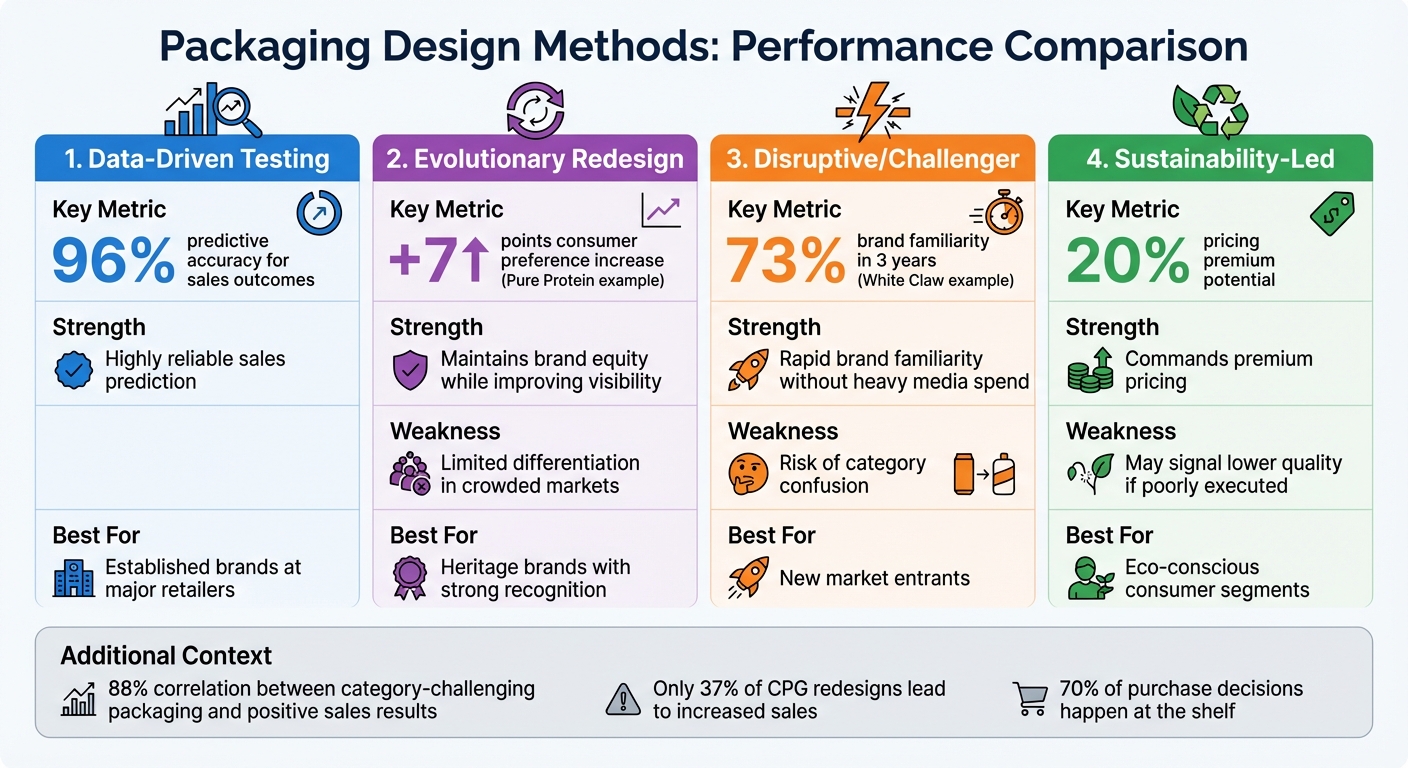
Packaging Design Methods Comparison: Strengths, Weaknesses and Best Applications
Packaging designs come with their own strengths and challenges, directly impacting how products perform on the shelf. Here’s a breakdown of different methods used to maximize shelf appeal and their trade-offs.
**Data-Driven Testing Methods** are highly effective at predicting sales performance before a product even hits the shelves. With a 96% correlation between purchase intent and actual sales outcomes, these methods offer a reliable way to gauge success.
**Evolutionary Redesign Methods** are ideal for established brands looking to refresh their look while maintaining brand equity. By building on familiar elements, this approach boosts visibility without alienating loyal customers. For example, [Pure Protein](https://www.pureprotein.com/)'s recent refresh - featuring enhanced flavor imagery and updated color schemes - resulted in a seven-point increase in consumer preference. However, these gradual updates might not stand out enough in crowded markets where bold innovation is necessary.
**Disruptive Design Methods** focus on creating instant recognition, even with limited advertising budgets. A standout example is [White Claw](https://www.whiteclaw.com/), which achieved 73% brand familiarity among category buyers within just three years of its 2016 launch, thanks to its striking wave design and high-contrast visuals. That said, overly aggressive designs can sometimes confuse shoppers.
**Sustainability-Led Approaches** can enhance a brand's identity and even justify a 20% price premium. That said, poorly executed eco-friendly materials might give off an impression of lower quality. Bulldog’s bamboo razor packaging, which ranked in the top 25% for design performance, shows how aligning sustainable materials with a broader eco-conscious strategy can elevate a brand’s premium appeal.
| Design Method | Key Strength | Potential Weakness | Best Application |
| --- | --- | --- | --- |
| **Data-Driven Testing** | 96% predictive accuracy for sales outcomes | - | Established brands at major retailers |
| **Evolutionary Redesign** | Maintains brand equity while improving visibility | Limited differentiation | Heritage brands with strong recognition |
| **Disruptive/Challenger** | Rapid brand familiarity without heavy media spend | Risk of category confusion | New market entrants |
| **Sustainability-Led** | Commands a 20% pricing premium | May signal lower quality if poorly executed | Eco-conscious consumer segments |
## Conclusion
Standing out on the shelf takes more than just a spark of creativity - it’s about **understanding your competitors** and making intentional choices to break away from the usual norms. Packaging that challenges category conventions while clearly communicating key purchase drivers has been shown to have an **88% correlation with positive sales results**.
Start by auditing your category to evaluate design performance and identify visual elements that work. Use early-stage consumer testing to refine your designs - it’s a critical step to avoid relying on assumptions. With only **37% of CPG redesigns leading to increased sales**, testing your designs in realistic contexts is far more effective than isolated evaluations.
To bring these strategies to life, PKG Brand Design’s [**Consumer First**](https://www.pkgbranding.com/approach)**® approach** offers a structured framework. This method zeroes in on three key factors inspired by Nielsen’s BASES: *Catching Attention, Connecting the Message,* and *Communicating Clearly*. Tools like Retail Immersion and Consumer Dialogue allow brands to see the shelf from the shopper’s perspective and refine designs through direct feedback. As PKG emphasizes:
> "Everything starts with the consumer. That's our only rule".
Don’t forget that physical placement is just as important as design. For top-shelf products, branding should be visible on the bottom or front panel; for bottom-shelf items, focus on the top. Also, make sure your design translates well to mobile thumbnails for e-commerce. Testing packaging within realistic competitive shelf setups - whether through VR or physical simulations - can reveal issues like unclear messaging or lack of differentiation.
The brands that succeed are those that combine **behavioral insights with smart design choices**. In fact, a 4-point increase in consumer purchase preference during testing often predicts strong sales performance in the market. By blending competitor analysis with consumer data, your packaging can break through the noise, challenge category norms, and ultimately drive sales.
## FAQs
### What should I audit first in a competitor packaging review?
Start by examining the essential elements of packaging, such as **design**, **color**, and **messaging**. These factors play a huge role in helping your product grab attention and stand out on the shelf. Take a close look at what works well - or doesn't - about existing packaging in your market. This analysis can guide you in crafting a strategy that sets your product apart.
### How can I test packaging before a full launch?
Testing packaging before a full launch is crucial to ensure it resonates with shoppers. One effective method is **shelf testing**, where you simulate a store aisle to assess how easily your product can be found, its visual appeal, and whether it encourages purchase intent. This process helps you confirm how well the packaging performs and make adjustments before committing to large-scale production.
Another valuable approach is **rapid iterative testing**. By gathering consumer feedback, you can gain insights into how your packaging behaves on the shelf. This allows you to fine-tune the design so it not only catches the eye but also connects with shoppers in a meaningful way.
### How do I balance sustainability with a premium look?
To combine an eco-conscious approach with a luxurious aesthetic, opt for materials like recycled or biodegradable options that still exude elegance. Incorporate creative textures, striking finishes, or bold colors to showcase both environmental responsibility and refined design. Partnering with specialists in sustainable materials and production processes can help you achieve packaging that reflects eco-friendly principles while maintaining a polished, high-end look.
## Related Blog Posts
- [How Strategic Packaging Design Increases Sales](https://www.pkgbranding.com/blog/strategic-packaging-design-increases-sales)
- [The Complete Guide to Structural Packaging Design](https://www.pkgbranding.com/blog/complete-guide-structural-packaging-design)
- [What Makes Packaging Design Effective: Q&A](https://www.pkgbranding.com/blog/what-makes-packaging-design-effective)
- [PKG’s Consumer Packaging Trend Analyzer](https://www.pkgbranding.com/blog/consumer-packaging-trend-analyzer)
- [Facebook Share ](https://www.facebook.com/sharer/sharer.php?u=https%3A%2F%2Fwww.pkgbranding.com%2Fblog%2Fcompetitor-analysis-for-shelf-differentiation)
- [Twitter Share ](https://twitter.com/home?status=Competitor+Analysis+for+Shelf+Differentiation%20https%3A%2F%2Fwww.pkgbranding.com%2Fblog%2Fcompetitor-analysis-for-shelf-differentiation)
- [LinkedIn Share ](https://www.linkedin.com/shareArticle?mini=true&url=https%3A%2F%2Fwww.pkgbranding.com%2Fblog%2Fcompetitor-analysis-for-shelf-differentiation&title=Competitor%20Analysis%20for%20Shelf%20Differentiation&summary=Use+competitor+analysis%2C+shopper+testing%2C+structural+design%2C+and+sustainable+materials+to+create+packaging+that+stands+out+on+crowded+retail+shelves.&source=)
- [Email Share ](mailto:?subject=Competitor%20Analysis%20for%20Shelf%20Differentiation&body=https%3A%2F%2Fwww.pkgbranding.com%2Fblog%2Fcompetitor-analysis-for-shelf-differentiation)
### Topics
- [Blog](https://www.pkgbranding.com/blog/topic/blog)
### Related Posts
[ How Multisensory Packaging Impacts Brand Loyalty Kevin Keating at PKG ](https://www.pkgbranding.com/blog/multisensory-packaging-impacts-brand-loyalty) [ 7 Emotional Triggers That Drive Packaging Success Kevin Keating at PKG ](https://www.pkgbranding.com/blog/emotional-triggers-packaging-success) [ How Social Media Listening Improves Packaging Design Kevin Keating at PKG ](https://www.pkgbranding.com/blog/social-media-listening-improves-packaging-design)
### Subscribe Now!
### Subscribe Now!
**Awarded Top 50**
**Package Design ****Blog**
[](http://blog.feedspot.com/packaging_design_blogs/)
- [How Multisensory Packaging Impacts Brand Loyalty](https://www.pkgbranding.com/blog/multisensory-packaging-impacts-brand-loyalty)
- [7 Emotional Triggers That Drive Packaging Success](https://www.pkgbranding.com/blog/emotional-triggers-packaging-success)
- [How Social Media Listening Improves Packaging Design](https://www.pkgbranding.com/blog/social-media-listening-improves-packaging-design)
- [11 Examples of Functional Packaging Features](https://www.pkgbranding.com/blog/functional-packaging-features-examples)
- [Competitor Analysis for Shelf Differentiation](https://www.pkgbranding.com/blog/competitor-analysis-for-shelf-differentiation)
- [Typography Checklist for Packaging](https://www.pkgbranding.com/blog/typography-checklist-packaging)
- [Top Biodegradable Packaging Myths Consumers Believe](https://www.pkgbranding.com/blog/biodegradable-packaging-myths-consumers-believe)
- [Macro Photography for Food Packaging Design](https://www.pkgbranding.com/blog/macro-photography-food-packaging-design)
- [Glass Packaging Benefits for CPG Brands](https://www.pkgbranding.com/blog/glass-packaging-benefits-cpg-brands)
- [Pet Food Packaging: FDA Rules to Know](https://www.pkgbranding.com/blog/pet-food-packaging-fda-rules)

Recognized as a
Top Package Design Agency
on [DesignRush](https://www.designrush.com/agency/package-design)
PKG BRAND DESIGN
2045 W Grand Ave, STE B-27332
Chicago, IL 60612-1576
[312.870.9101](tel:+1.312.870.9101)
 [Request a Free Consultation](https://www.pkgbranding.com/request-a-consultation)
[](https://www.hangar-12.com/)
© 2026 PKG Brand Design. All Rights Reserved

```json
{
"@context" : "http://schema.org",
"@type" : "BlogPosting",
"author" : {
"@type" : "Person",
"name" : "Kevin Keating at PKG"
},
"dateModified" : "April 13, 2026, 7:06:43 PM",
"datePublished" : "2026-02-24 03:39:22",
"description" : "Use competitor analysis, shopper testing, structural design, and sustainable materials to create packaging that stands out on crowded retail shelves.",
"headline" : "Competitor Analysis for Shelf Differentiation",
"image" : {
"@type" : "ImageObject",
"url" : "https://assets.seobotai.com/cdn-cgi/image/quality=75,w=1536,h=1024/pkgbranding.com/699d1567efc60cc2af09861b-1771904438258.jpg"
},
"publisher" : {
"@type" : "Organization",
"logo" : {
"@type" : "ImageObject",
"url" : "https://cdn2.hubspot.net/hubfs/537000/PKG-1.png"
},
"name" : "PKG Brand Design"
}
}
```
```json
{
"@context" : "https://schema.org",
"@type" : "FAQPage",
"mainEntity" : [ {
"@type" : "Question",
"acceptedAnswer" : {
"@type" : "Answer",
"text" : "Start by examining the essential elements of packaging, such as design, color, and messaging. These factors play a huge role in helping your product grab attention and stand out on the shelf. Take a close look at what works well - or doesn't - about existing packaging in your market. This analysis can guide you in crafting a strategy that sets your product apart.
"
},
"name" : "What should I audit first in a competitor packaging review?"
}, {
"@type" : "Question",
"acceptedAnswer" : {
"@type" : "Answer",
"text" : "Testing packaging before a full launch is crucial to ensure it resonates with shoppers. One effective method is shelf testing, where you simulate a store aisle to assess how easily your product can be found, its visual appeal, and whether it encourages purchase intent. This process helps you confirm how well the packaging performs and make adjustments before committing to large-scale production.
Another valuable approach is rapid iterative testing. By gathering consumer feedback, you can gain insights into how your packaging behaves on the shelf. This allows you to fine-tune the design so it not only catches the eye but also connects with shoppers in a meaningful way.
"
},
"name" : "How can I test packaging before a full launch?"
}, {
"@type" : "Question",
"acceptedAnswer" : {
"@type" : "Answer",
"text" : "To combine an eco-conscious approach with a luxurious aesthetic, opt for materials like recycled or biodegradable options that still exude elegance. Incorporate creative textures, striking finishes, or bold colors to showcase both environmental responsibility and refined design. Partnering with specialists in sustainable materials and production processes can help you achieve packaging that reflects eco-friendly principles while maintaining a polished, high-end look.
"
},
"name" : "How do I balance sustainability with a premium look?"
} ]
}
```